Automated Root Cause Analysis of Network Failures in IPMPLS Network Using Machine Learning and Case-Based Reasoning
Objective
The project, Automated Root Cause Analysis of Network Failures in IPMPLS Network Using Machine Learning and Case-Based Reasoning, aims to streamline and automate the identification of root causes behind network failures in IP/MPLS environments. By leveraging machine learning models and case-based reasoning techniques, it analyzes network traffic data to detect anomalies and classify failure patterns. This helps network administrators quickly diagnose issues, reduce downtime, and improve network reliability. The web application facilitates secure user access, dataset uploads, model evaluation, and real-time prediction, ultimately enabling efficient, data-driven troubleshooting and proactive network management.
Abstract
Modern IPMPLS (Internet Protocol – Multi-Protocol Label Switching) networks form the backbone of enterprise and service provider infrastructures, where uptime and reliability are critical. However, due to the complex and dynamic nature of such networks, diagnosing the root cause of failures remains a significant operational challenge. This project proposes an intelligent, automated framework for root cause analysis using a hybrid approach of Machine Learning (ML) and Case-Based Reasoning (CBR). The system integrates user-friendly web functionalities built with Flask, including dataset upload, model selection, prediction interfaces, and visualization modules.
Upon uploading packet capture or flow-level data, the system preprocesses the input and applies a trained Decision Tree or ensemble model to classify the anomaly level. Each classification is mapped to human-readable insights ranging from benign traffic to confirmed threat levels. Further, the architecture leverages historical cases and associated resolutions to offer contextual root cause insights, thereby reducing downtime and manual intervention. Performance metrics of various models including XGBoost, Random Forest, Logistic Regression, and Stacking Classifiers are also reported to guide algorithm selection. This solution empowers network administrators with faster, more accurate fault identification, enabling proactive remediation strategies in complex IPMPLS environments.
Keywords:
IPMPLS Networks, Root Cause Analysis, Machine Learning, Case-Based Reasoning,
Anomaly Detection, Flask Web Application, Decision Tree Classifier, Network
Security, Automated Diagnosis, Predictive Analytics
NOTE: Without the concern of our team, please don't submit to the college. This Abstract varies based on student requirements.
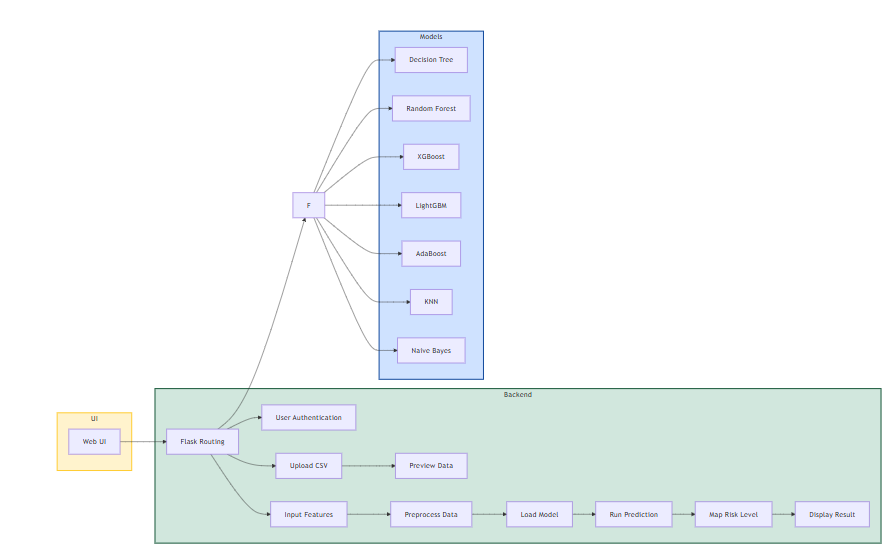
Block Diagram
Specifications
SOFTWARE REQUIREMENS
Operating System : Windows 7/8/10
Server side Script : HTML, CSS, Bootstrap & JS
Programming Language : Python
Libraries : Django, Pandas, Os, Numpy, Scikit-learn, XGBoost.
IDE/Workbench : VS Code
Technology : Python 3.10
Database : SQLite
HARDWARE REQUIREMENTS
Processor - I3/Intel Processor
Hard Disk - 160GB
Key Board - Standard Windows Keyboard
Mouse - Two or Three Button Mouse
Monitor - SVGA
RAM -8GB
Demo Video


Request for Video
Related Projects
 Paper Publishing
Request Call Back
Would you like to receive a free callback now?
Choose the best time for callback:
Leave your message and we will contact you as soon as possible

6-2-85/B, Old Maternity Hospital Road, Thyagaraja Nagar, Tirupati, Andhra Pradesh – 517501
+91 9030333433
+91 9393939065
0877-2261612

Disclaimer - Takeoff Edu Group Projects are not associated or affiliated with IEEE in any way. The IEEE Projects mentioned here are mentioned in the context of student projects, whose ideas are derived from IEEE publications, not projects of or by IEEE.

