Arithmetic Logic Unit using 4-bit Vedic Multipliers with Multiplexers
Objective
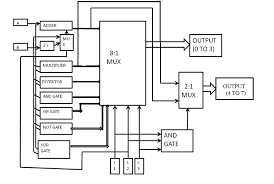
The objective of this project is to design and implement an Arithmetic Logic Unit (ALU) using 4-bit Vedic multipliers integrated with multiplexers for efficient arithmetic and logical operations. It focuses on enhancing the speed and performance of the ALU by utilizing the Urdhva Tiryakbhayam sutra from Vedic mathematics. The design will be simulated and verified to ensure accurate functionality and reduced computational delay. Multiplexers are used to select between different operations, improving flexibility and control. The overall goal is to develop a high-performance, low-latency ALU suitable for modern digital processing applications
Abstract
Abstract:
This paper designs an 4-bit Arithmetic Logic Unit (ALU) based on multiplexers in order to construct Vedic multipliers in Verilog HDL. The Urdhva Tiryakbhayam Sutra, based on the 'Vertically and Crosswise' approach, generates partial products in parallel and makes multiplication faster and reduces hardware complexity. Along with multiplication, the ALU is also performing addition, subtraction, logical shifts, and bitwise operations. The optimized design have been simulated and synthesized with the use of industry-standard tools to maximize the utilization of resources in computation.NOTE: Without the concern of our team, please don't submit to the college. This Abstract varies based on student requirements.
Block Diagram
Specifications
Software Requirements:
· Xilinx ISE14.7 Suite/Vivado2018.3 Tool.
· HDL: Verilog.
Hardware Requirements:
· Microsoft® Windows XP.
· Intel® Pentium® 4 processor or Pentium 4 equivalent with SSE support.
· 512 MB RAM.
· 100 MB of available disk space.
Learning Outcomes
1. Understanding of ALU architecture and operation.
2. Knowledge of Vedic multiplication techniques.
3. Experience in Verilog HDL coding and simulation.
4. Ability to analyze power, delay, and area trade-offs.
5. Hands-on experience with FPGA synthesis tools.
6. Skills in designing efficient arithmetic units for digital systems.


Related Projects
 Paper Publishing

Request Call Back
Would you like to receive a free callback now?
Choose the best time for callback:
Leave your message and we will contact you as soon as possible

6-2-85/B, Old Maternity Hospital Road, Thyagaraja Nagar, Tirupati, Andhra Pradesh – 517501
+91 9030333433
+91 9393939065
0877-2261612

Disclaimer - Takeoff Edu Group Projects are not associated or affiliated with IEEE in any way. The IEEE Projects mentioned here are mentioned in the context of student projects, whose ideas are derived from IEEE publications, not projects of or by IEEE.

