Applying Machine Learning Techniques to improve Linux Process Scheduling
Objective
To predict Linux process CPU burst time (STS_Class) using ML algorithms, compare model performance, optimize scheduling efficiency, and deploy an interactive web application for real-time predictions
Abstract
APPLYING MACHINE LEARNING TECHNIQUES TO IMPROVE LINUX PROCESS SCHEDULING
ABSTRACT
In this study, we explore the application of machine learning (ML) techniques to enhance the efficiency of Linux process scheduling. Specifically, we focus on predicting CPU burst times by analyzing both static and dynamic attributes of running processes. Our goal is to identify the key attributes that can accurately predict CPU burst times, thereby minimizing the process Turn-around-Time (TaT). We modify the Linux Kernel scheduler (version 2.4.20-8) to implement a scheduling mechanism that utilizes customized time slices based on the predictions. Using the Waikato Environment for Knowledge Analysis (Weka), an open-source ML tool, we evaluate various algorithms to determine the most effective method for this task. Our experimentation reveals that the C4.5 Decision Tree algorithm provides the best performance, leading to a reduction in TaT by 1.4% to 5.8%, primarily due to fewer context switches. These findings suggest that incorporating predictive scheduling, which leverages a program’s execution history, can significantly improve process scheduling in modern operating systems.
Keywords: Machine learning, process scheduling, Linux kernel, CPU burst prediction, C4.5,Decision Tree, Turn-around-Time, context switches, Weka.
NOTE: Without the concern of our team, please don't submit to the college. This Abstract varies based on student requirements.
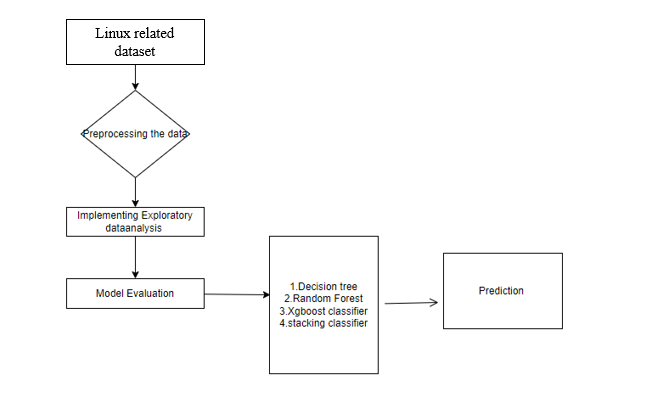
Block Diagram
Specifications
H/W CONFIGURATION:
Processor - I3/Intel Processor
Hard Disk - 160GB
Key Board - Standard Windows Keyboard
Mouse - Two or Three Button Mouse
Monitor - SVGA
RAM - 8GB
S/W CONFIGURATION:
• Operating System : Windows 7/8/10
• Server side Script : HTML, CSS, Bootstrap & JS
• Programming Language : Python
• Libraries : Flask, Pandas, Mysql.connector, Os, Scikit-learn, Numpy
• IDE/Workbench : PyCharm
• Technology : Python 3.6+
• Server Deployment : Xampp Server


Related Projects
 Paper Publishing

Request Call Back
Would you like to receive a free callback now?
Choose the best time for callback:
Leave your message and we will contact you as soon as possible

6-2-85/B, Old Maternity Hospital Road, Thyagaraja Nagar, Tirupati, Andhra Pradesh – 517501
+91 9030333433
+91 9393939065
0877-2261612

Disclaimer - Takeoff Edu Group Projects are not associated or affiliated with IEEE in any way. The IEEE Projects mentioned here are mentioned in the context of student projects, whose ideas are derived from IEEE publications, not projects of or by IEEE.

