An Optimized Post-Quantum Attribute-Based Encryption Framework for Cloud Computing
Objective
The goal of this project is to design and implement a secure, practical, and efficient post-quantum attribute-based encryption (ABE) scheme utilizing rank metric codes. This scheme aims to address the vulnerabilities introduced by quantum computing to traditional cryptographic protocols in cloud environments. The primary objectives include ensuring robust security against chosen plaintext and ciphertext attacks, while simultaneously guaranteeing verifiability, user privacy, and revocability. Moreover, the project focuses on optimizing key size and execution time to improve efficiency on standard computing platforms, offering a reliable solution for secure data storage and sharing in the quantum era.
Abstract
An Optimized Post-Quantum Attribute-Based Encryption Framework for Cloud Computing
ABSTRACT:
Attribute-based encryption (ABE) is crucial for ensuring data privacy in cloud computing environments, enabling secure storage and sharing of data. However, the rise of quantum processors presents a significant threat to existing cryptographic protocols by potentially compromising security measures such as factoring large integers and computing discrete logarithms. In response, this paper introduces a novel post-quantum attribute-based encryption scheme based on rank metric codes. Unlike previous schemes, our approach simultaneously addresses key challenges such as verifiability, user privacy, and revocability. By leveraging low-rank parity-check codes, our scheme is designed to resist chosen plaintext attacks in the standard model and offers robustness against reaction attacks, including chosen ciphertext attacks. The scheme also accounts for new attack vectors, where an attacker can breach the system by exploiting file search functionalities and logging out. This adds an important layer of complexity to the system's security analysis, considering how attackers can interfere with secure file sharing and access mechanisms.
Keywords: Attribute-based encryption, rank metric codes, user privacy, user revocation, file attack, cloud security.
NOTE: Without the concern of our team, please don't submit to the college. This Abstract varies based on student requirements.
Block Diagram
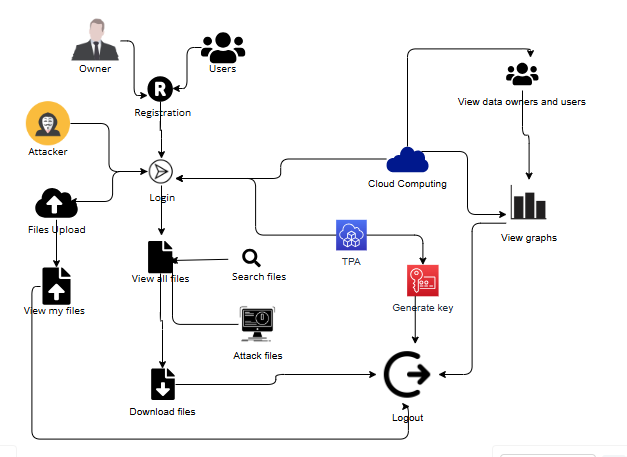
Specifications
HARDWARE AND SOFTWARE REQUIREMENTS
Hardware Requirements
Processor - I3/Intel Processor
Hard Disk - 160GB
Key Board - Standard Windows Keyboard
Mouse - Two or Three Button Mouse
Monitor - SVGA
RAM - 8GB
Software Requirements:
Operating System : Windows 7/8/10
Server side Script : HTML, CSS, Bootstrap & JS
Programming Language : Python
Libraries : Flask, Pandas, Mysql.connector, Os, Smtplib, Numpy
IDE/Workbench : PyCharm
Technology : Python 3.6+
Server Deployment : Xampp Server
Database : MySQL


Related Projects
 Paper Publishing

Request Call Back
Would you like to receive a free callback now?
Choose the best time for callback:
Leave your message and we will contact you as soon as possible

6-2-85/B, Old Maternity Hospital Road, Thyagaraja Nagar, Tirupati, Andhra Pradesh – 517501
+91 9030333433
+91 9393939065
0877-2261612

Disclaimer - Takeoff Edu Group Projects are not associated or affiliated with IEEE in any way. The IEEE Projects mentioned here are mentioned in the context of student projects, whose ideas are derived from IEEE publications, not projects of or by IEEE.

