Air Quality Index Forecasting Via Genetic Algorithm Based Improved Extreme
Objective
The objective of this project is to develop an innovative approach for forecasting Air Quality Index (AQI) levels by integrating a Genetic Algorithm (GA)-based Improved Extreme Learning Machine (IELM) model. Leveraging a comprehensive dataset comprising various pollutants and meteorological parameters across different cities, the aim is to enhance the accuracy of AQI prediction. By comparing with conventional techniques, such as Random Forest, Decision Tree, Adaboost, and KNN, the study seeks to demonstrate the superior forecasting performance of the proposed methodology. This research aims to contribute to advancing air quality monitoring and management systems, facilitating proactive measures to mitigate air pollution and safeguard public health.
Abstract
This study presents an innovative approach for Air Quality Index (AQI) forecasting utilizing a Genetic Algorithm (GA)-based Improved Extreme Learning Machine (IELM) model. The proposed method integrates the strengths of GA optimization with the enhanced learning capability of IELM to accurately predict AQI levels. Leveraging a comprehensive dataset encompassing various pollutants and meteorological parameters across different cities, including PM2.5, PM10, NO, NO2, NOx, NH3, CO, SO2, O3, Benzene, Toluene, and Xylene, the model achieves superior forecasting performance. By comparing with conventional techniques such as Random Forest, Decision Tree, AdaBoost, and KNN, our approach demonstrates its efficacy in AQI prediction. This research contributes to advancing air quality monitoring and management systems, aiding policymakers and stakeholders in implementing proactive measures to mitigate air pollution and safeguard public health.
KEYWORDS: Random Forest, Decision Tree, AdaBoost, and KNN.
NOTE: Without the concern of our team, please don't submit to the college. This Abstract varies based on student requirements.
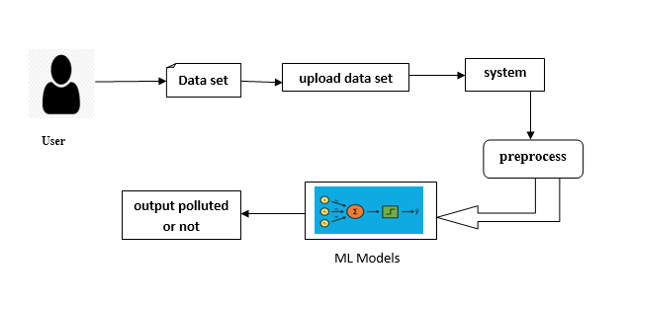
Block Diagram
Specifications
H/W CONFIGURATION:
Processor I3/Intel Processor
Hard Disk 160GB
Key Board Standard Windows Keyboard
Mouse Two or Three Button Mouse
Monitor SVGA
RAM 8GB
S/W CONFIGURATION:
• Operating System : Windows 7/8/10
• Server side Script : HTML, CSS, Bootstrap & JS
• Programming Language : Python
• Libraries : Flask, Pandas, Mysql.connector, Numpy
• IDE/Workbench : VS Code
• Technology : Python 3.6+


Related Projects
 Paper Publishing

Request Call Back
Would you like to receive a free callback now?
Choose the best time for callback:
Leave your message and we will contact you as soon as possible

6-2-85/B, Old Maternity Hospital Road, Thyagaraja Nagar, Tirupati, Andhra Pradesh – 517501
+91 9030333433
+91 9393939065
0877-2261612

Disclaimer - Takeoff Edu Group Projects are not associated or affiliated with IEEE in any way. The IEEE Projects mentioned here are mentioned in the context of student projects, whose ideas are derived from IEEE publications, not projects of or by IEEE.

