AIDRIVEN ADAPTIVE ANALYTICS FOR SMART EDUCATIONAL SYSTEM
Objective
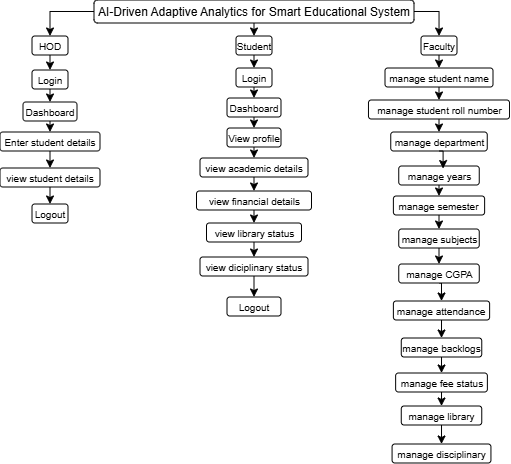
The primary objective of this project is to develop a web-based Attendance Management System that automates the process of recording, managing, and monitoring student attendance in an educational institution. The system aims to provide secure, role-based access for HODs, faculty members, and students to ensure proper control and data confidentiality. It focuses on enabling faculty to record attendance efficiently, allowing HODs to manage student details and generate attendance and marks reports, and providing students with transparent access to their attendance and academic performance. Additionally, the project seeks to minimize manual effort, reduce errors, improve data accuracy, and offer a user-friendly interface using HTML, CSS, and JavaScript, with a reliable and secure back-end developed using Python and the Django framework.
Abstract
The "AI-Driven Adaptive Analytics for Smart Educational System" is designed to leverage the power of artificial intelligence algorithms to enhance the educational experience through data-driven insights. The system collects and analyzes vast amounts of data generated by students' interactions with the educational content, such as test scores, assignments, attendance, and real-time feedback. By utilizing advanced AI models, the system adapts to the unique learning style and pace of each student, ensuring personalized recommendations and interventions. It employs predictive analytics to forecast student performance, detect learning gaps, and identify students who may need additional support. Educators are empowered with real-time analytics and dashboards, allowing them to monitor student progress, tailor their teaching strategies, and provide timely feedback. The system also integrates adaptive learning techniques, which adjust the difficulty of content based on individual proficiency, ensuring that each student is continually challenged and supported. The use of AI in educational systems is poised to transform the traditional classroom by creating an intelligent, dynamic environment that fosters engagement, promotes individualized learning, and ultimately leads to improved academic outcomes. Additionally, this smart system can help optimize institutional operations, from administrative decision-making to resource management, making education more effective, efficient, and equitable for all stakeholders.
Keywords:
AI-Driven Adaptive Analytics, Smart Educational System, Predictive Analytics,
Personalized Learning Paths, Student Performance Prediction, Adaptive Learning,
Real-Time Data Analysis, Django, Python, SQL, HTML, CSS, Educational
Technology, Data-Driven Education, Learning Analytics, Educational Data
Processing, Curriculum Optimization, Student Engagement, Web Application, AI in
Education, Performance Monitoring, Interactive Learning Environment.
NOTE: Without the concern of our team, please don't submit to the college. This Abstract varies based on student requirements.
Block Diagram
Specifications
H/W CONFIGURATION:
Processor - I3/Intel Processor
Hard Disk - 160GB
Key Board - Standard Windows Keyboard
Mouse - Two or Three Button Mouse
Monitor - SVGA
RAM - 8GB
S/W CONFIGURATION:
Operating System : Windows 10
Server-side Script : Python 3.6
IDE : Pycharm, VS code
Libraries Used : Django


Related Projects
 Paper Publishing

Request Call Back
Would you like to receive a free callback now?
Choose the best time for callback:
Leave your message and we will contact you as soon as possible

6-2-85/B, Old Maternity Hospital Road, Thyagaraja Nagar, Tirupati, Andhra Pradesh – 517501
+91 9030333433
+91 9393939065
0877-2261612

Disclaimer - Takeoff Edu Group Projects are not associated or affiliated with IEEE in any way. The IEEE Projects mentioned here are mentioned in the context of student projects, whose ideas are derived from IEEE publications, not projects of or by IEEE.

