AI vs Human Academic Essay Authenticity Challenge
Objective
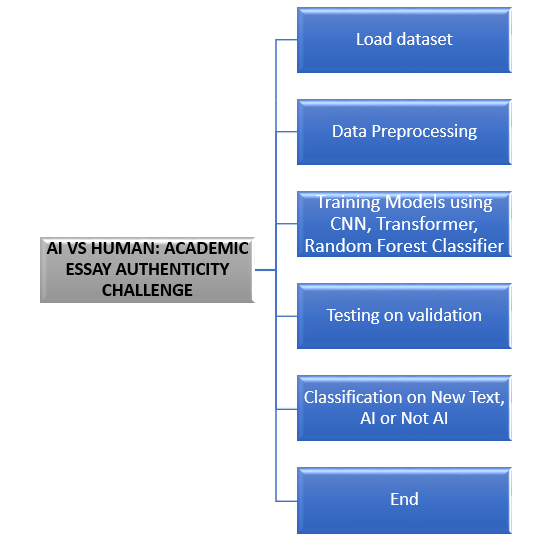
The "AI VS HUMAN: ACADEMIC ESSAY AUTHENTICITY CHALLENGE" project develops a machine learning system to distinguish between AI-generated and human-written text It utilizes various algorithms, including CNN, BERT, and Random Forest Classifiers.
Abstract
AI VS HUMAN: ACADEMIC ESSAY AUTHENTICITY CHALLENGE
ABSTRACT
The rise of artificial intelligence (AI) has transformed many industries, including the academic sector, where AI-generated essays pose a threat to academic integrity. This project, titled "AI VS HUMAN: ACADEMIC ESSAY AUTHENTICITY CHALLENGE," focuses on developing a system to differentiate between AI-generated and human-written academic essays. The core objective is to design a machine learning-based solution that accurately classifies text as either AI-generated or human-authored. The system leverages multiple machine learning algorithms, including Convolutional Neural Networks (CNN), Transformer models, and Random Forest Classifiers, to analyze and predict text origins using English text data. Additionally, the frontend is designed to accept user input in both English and Arabic. For Arabic input, the text is first translated into English before classification, enabling seamless detection of AI-generated content across multiple languages. The model is trained on a diverse dataset consisting of academic essays, including those written by both AI and humans. Through extensive training and evaluation, the model’s performance is assessed based on accuracy and precision in distinguishing between human-written and AI-generated texts. This tool can assist educators, researchers, and academic institutions in identifying non-original content and promoting academic honesty. The project ultimately aims to combat the growing challenge of AI in academia by providing an efficient and reliable solution for authenticity detection.
Keywords: AI detection, human-written, AI-generated, academic integrity, essay authenticity, machine learning, CNN, Transformer, Random Forest Classifier, text classification.
NOTE: Without the concern of our team, please don't submit to the college. This Abstract varies based on student requirements.
Block Diagram
Specifications
SOFTWARE HARDWARE REQUIREMENTS
H/W CONFIGURATION:
Processor - I3/Intel Processor
Hard Disk - 160GB
Key Board - Standard Windows Keyboard
Mouse - Two or Three Button Mouse
Monitor - SVGA
RAM - 8GB
S/W CONFIGURATION:
• Operating System : Windows 7/8/10
• Programming Language : Python
• Libraries : Pandas, Tensor flow, Keras, Streamlit
• IDE/Workbench : VS Code
• Technology : Python 3.8+

Demo Video


Request for Video
Related Projects
 Paper Publishing
Request Call Back
Would you like to receive a free callback now?
Choose the best time for callback:
Leave your message and we will contact you as soon as possible

6-2-85/B, Old Maternity Hospital Road, Thyagaraja Nagar, Tirupati, Andhra Pradesh – 517501
+91 9030333433
+91 9393939065
0877-2261612

Disclaimer - Takeoff Edu Group Projects are not associated or affiliated with IEEE in any way. The IEEE Projects mentioned here are mentioned in the context of student projects, whose ideas are derived from IEEE publications, not projects of or by IEEE.

