AI-powered autism detection using facial expressions and eye tracking features
Objective
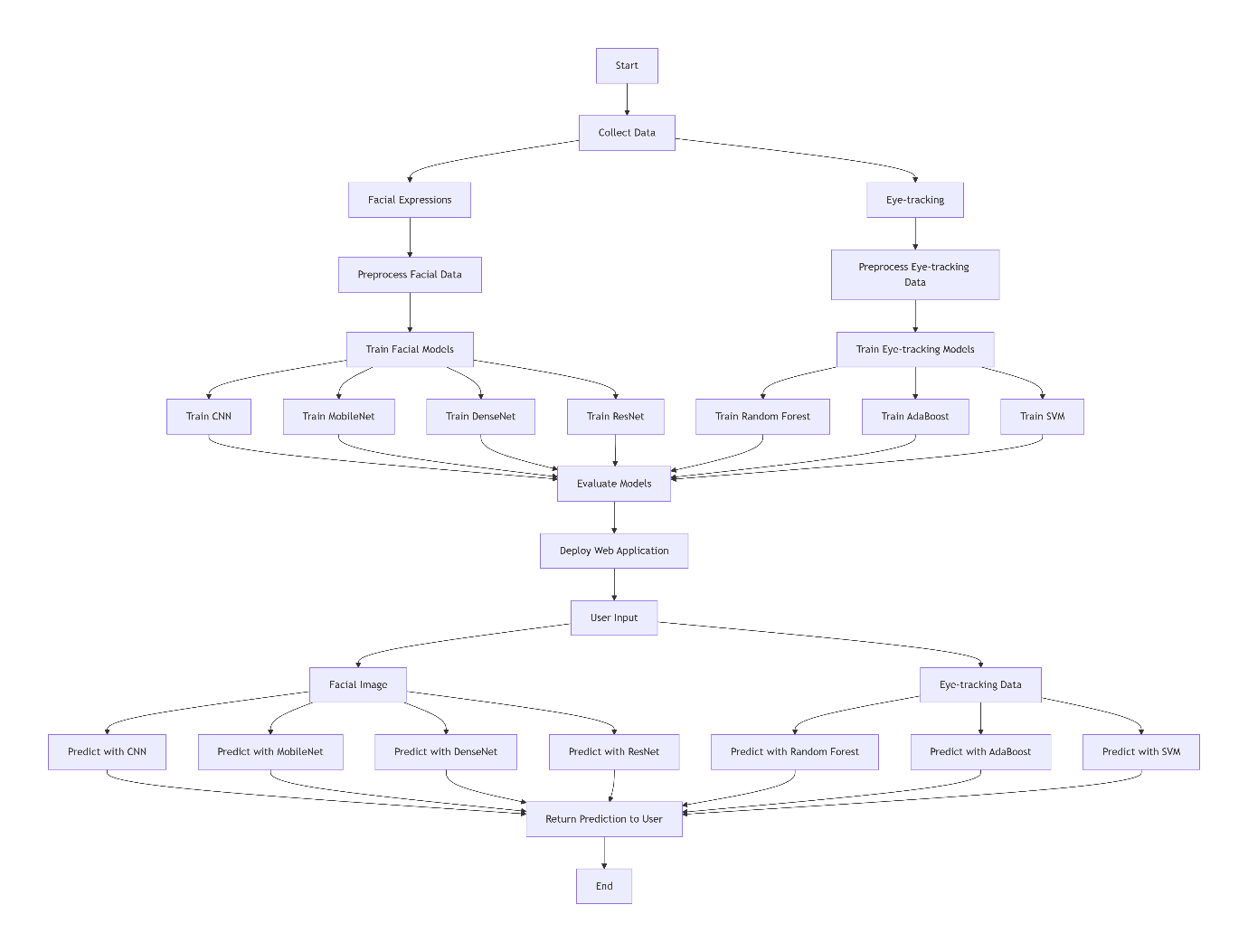
The primary objective of this project is to develop an AI-powered system that detects autism by analyzing facial expressions and eye-tracking data. The system aims to leverage deep learning models such as Convolutional Neural Networks (CNN), MobileNet, DenseNet, and ResNet for facial expression recognition, and machine learning algorithms like Support Vector Machines (SVM), RandomForestClassifier, CNN, and AdaBoostClassifier for analyzing eye-tracking features. The goal is to provide a user-friendly web platform that allows users to upload facial images and eye-tracking data for automated analysis and autism prediction. The system is designed to be intuitive, offering a seamless experience for both users and professionals. By using Python with Flask for the back-end, the platform will ensure secure, fast, and scalable processing of the input data. This project aims to improve early autism detection, helping to identify potential cases more quickly, facilitating timely interventions, and supporting professionals in making informed decisions. Furthermore, the system will be evaluated and optimized to ensure high accuracy, making it a reliable tool for early autism diagnosis.
Abstract
Autism spectrum disorder (ASD) is a neurodevelopmental condition that affects communication, social interaction, and behavior. Early detection and intervention are crucial for improving outcomes, but traditional diagnostic methods often rely on subjective assessments and lengthy observations. This project introduces an AI-powered solution for autism detection, leveraging facial expressions and eye-tracking data. The system utilizes advanced machine learning algorithms to identify patterns and characteristics that are indicative of autism.
The project integrates facial expression recognition using deep learning models such as Convolutional Neural Networks (CNN), MobileNet, DenseNet, and ResNet. These models are trained on a dataset of facial expressions from children with autism and non-autistic children. Additionally, eye-tracking features, such as gaze points and fixation durations, are analyzed using machine learning techniques, including Support Vector Machines (SVM), RandomForestClassifier, CNN, and AdaBoostClassifier.
By using these two distinct modalities, the system aims to provide an efficient, accessible, and non-invasive method for autism detection. The web-based platform enables users to upload facial expressions and eye-tracking data, which are then classified to provide predictions about autism. This tool has the potential to assist professionals in identifying early signs of autism, providing timely support for children and their families. The system is built with a user-friendly interface, using HTML, CSS, and JavaScript for the front-end, and Python with Flask for the back-end.
Keywords: Autism, Early detection, Facial expressions, Eye-tracking, Machine learning, CNN, MobileNet, DenseNet, ResNet, SVM.
NOTE: Without the concern of our team, please don't submit to the college. This Abstract varies based on student requirements.
Block Diagram
Specifications
HARDWARE REQUIREMENTS
• Processor - I5/Intel Processor
• RAM - 8GB (min)
• Hard Disk - 160 GB
• Key Board - Standard Windows Keyboard
• Mouse - Two or Three Button Mouse
• Monitor - Any
SOFTWARE REQUIREMENS
• Operating System : Windows 7/8/10
• Server side Script : HTML, CSS, Bootstrap & JS
• Programming Language : Python
• Libraries : Flask, Pandas, Mysql.connector, Os, Numpy,
Scikit-learn.
• IDE/Workbench : VS-Code
• Technology : Python 3.10+
• Server Deployment : Xampp Server
• Database : MySQL


Related Projects
 Paper Publishing

Request Call Back
Would you like to receive a free callback now?
Choose the best time for callback:
Leave your message and we will contact you as soon as possible

6-2-85/B, Old Maternity Hospital Road, Thyagaraja Nagar, Tirupati, Andhra Pradesh – 517501
+91 9030333433
+91 9393939065
0877-2261612

Disclaimer - Takeoff Edu Group Projects are not associated or affiliated with IEEE in any way. The IEEE Projects mentioned here are mentioned in the context of student projects, whose ideas are derived from IEEE publications, not projects of or by IEEE.

