AI enabled water well predicter
Objective
Utilize machine learning algorithms such as Random Forest, Gradient Boosting, and Linear Regression to make initial predictions.Enhance prediction accuracy by incorporating advanced techniques such as Long Short-Term Memory (LSTM) and Stacking Regressor.
Abstract
Keywords: Net Ground Water Availability, Machine Learning, Random Forest, Gradient Boosting, Linear Regression, XAI, LSTM, Stacking Regressor, Groundwater Prediction, Future Resource Management.
NOTE: Without the concern of our team, please don't submit to the college. This Abstract varies based on student requirements.
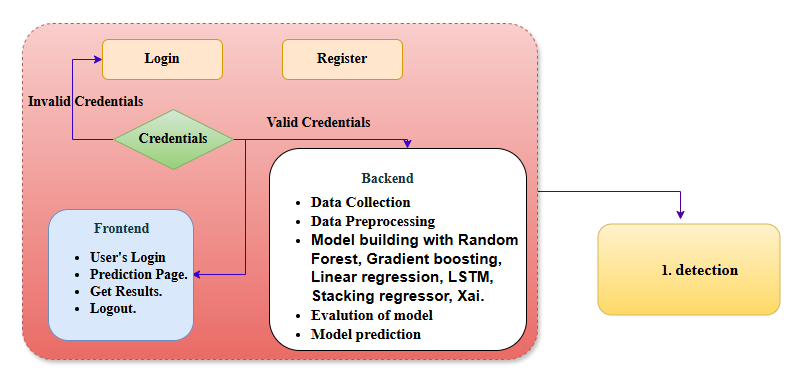
Block Diagram
Specifications
4.2 Hardware Requirements
The system's hardware requirements will depend on the volume of data to be processed, the complexity of the models, and the desired performance. The following are the general hardware requirements for the system:
- Processor: A multi-core processor (Intel i5 or equivalent) to handle parallel data processing and model training efficiently.
- Memory (RAM): A minimum of 16 GB of RAM for efficient handling of large datasets and running machine learning models.
- Storage: At least 500 GB of storage for storing large datasets, trained models, and generated reports.
- Graphics Processing Unit (GPU): A GPU with at least 4 GB of VRAM for accelerating deep learning models such as LSTM during training, if using deep learning approaches.
- Network: A stable and fast network connection for downloading datasets, model updates, and remote access to cloud services, if needed.
4.3 Software Requirements
- Operating System: A server-based operating system, such as Ubuntu or Windows Server, for hosting the application.
- Programming Languages:
- Python: For implementing machine learning algorithms (Random Forest, Gradient Boosting, LSTM, etc.) and preprocessing data.
- SQL: For database management and querying groundwater-related datasets.
- Machine Learning Libraries:
- Scikit-learn: For implementing models like Random Forest, Gradient Boosting, and Linear Regression.
- Keras/TensorFlow/PyTorch: For building and training LSTM models and integrating deep learning techniques.
- XAI Libraries: LIME and SHAP for implementing Explainable AI and model interpretability features.
- Database: A relational database such as MySQL or PostgreSQL for storing historical groundwater data and model predictions.
- Web Framework: A web framework like Flask or Django for developing the user interface and managing backend services.
- Visualization Tools: Tools like Matplotlib or Plotly for creating graphical representations of groundwater predictions and trends.
- Version Control: Git for version control and collaborative development of the system.

Demo Video


Request for Video
Related Projects
 Paper Publishing
Request Call Back
Would you like to receive a free callback now?
Choose the best time for callback:
Leave your message and we will contact you as soon as possible

6-2-85/B, Old Maternity Hospital Road, Thyagaraja Nagar, Tirupati, Andhra Pradesh – 517501
+91 9030333433
+91 9393939065
0877-2261612

Disclaimer - Takeoff Edu Group Projects are not associated or affiliated with IEEE in any way. The IEEE Projects mentioned here are mentioned in the context of student projects, whose ideas are derived from IEEE publications, not projects of or by IEEE.

