Advancing Ovarian Cancer Research for Enhanced Subtype Classification and Outlier Detection
Objective
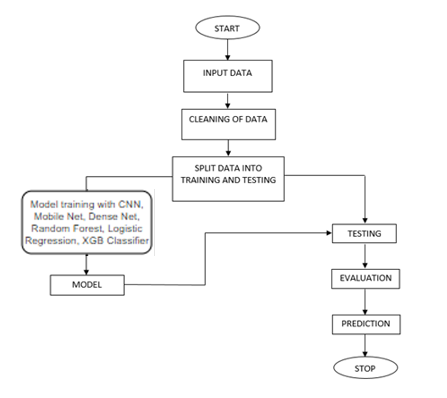
The project aims to revolutionize ovarian cancer diagnostics and treatment planning by employing advanced computational techniques. It focuses on developing a robust image analysis system using Convolutional Neural Networks (CNNs) like MobileNet and DenseNet to classify histopathological images into distinct ovarian cancer subtypes. Additionally, machine learning algorithms will analyze numeric data to detect anomalies indicative of Polycystic Ovary Syndrome (PCOS). By integrating image-based subtype classification with numeric data analysis, the project seeks to enhance understanding of ovarian cancer's complexities and improve patient care, thereby advancing oncology research and patient outcomes.
Abstract
Ovarian cancer remains a significant challenge in the realm of oncology due to its heterogeneous nature and often late-stage diagnosis. Addressing this, we propose a comprehensive approach to ovarian cancer research focusing on subtype classification and outlier detection using both image and numeric data. For the image data, we utilize a combination of Convolutional Neural Networks (CNN) and MobileNet, DenseNet architectures trained on a curated dataset comprising various ovarian cancer subtypes, including High-Grade Serous Carcinoma (HGSC), Clear-Cell Ovarian Carcinoma (CC), Endometrioid (EC), Low-Grade Serous Carcinoma (LGSC), and Mucinous Carcinoma (MC). Upon uploading an image, our model will predict the subtype with high accuracy, facilitating precise diagnosis and treatment planning. In parallel, for numeric data analysis, we leverage a dataset focusing on Polycystic Ovary Syndrome (PCOS) and employ outlier detection techniques. Our approach involves applying algorithms such as Logistic Regression, Decision Trees, Random Forest, and XGBoost to identify anomalies indicative of PCOS presence. This dual-pronged strategy enables a holistic understanding of ovarian cancer, combining advanced image analysis with numeric insights for comprehensive patient care. The proposed backend implementation in Python ensures robust model development and deployment, while the frontend built using HTML, CSS, and JavaScript provides an intuitive user interface for seamless interaction. Together, our methodology aims to advance ovarian cancer research, enhance subtype classification accuracy, and improve outlier detection for better patient outcomes.
Keywords: Ovarian cancer, Subtype classification, Outlier detection, Convolutional Neural Networks (CNN), MobileNet, DenseNet, High-Grade Serous Carcinoma (HGSC).
NOTE: Without the concern of our team, please don't submit to the college. This Abstract varies based on student requirements.
Block Diagram
Specifications
Hardware Requirements
Processor - I3/Intel Processor
Hard Disk - 160GB
Key Board - Standard Windows Keyboard
Mouse - Two or Three Button Mouse
Monitor - SVGA
RAM - 8GB
Software Requirements:
Operating System : Windows 7/8/10/11
Server side Script : HTML, CSS, Bootstrap & JS
Programming Language : Python
Libraries : Flask, Pandas, Mysql.connector, Os, Smtplib, Numpy
IDE/Workbench : PyCharm or VS Code
Technology : Python 3.6+
Server Deployment : Xampp Server
Database : MySQL

Demo Video


Request for Video
Related Projects
 Paper Publishing
Request Call Back
Would you like to receive a free callback now?
Choose the best time for callback:
Leave your message and we will contact you as soon as possible

6-2-85/B, Old Maternity Hospital Road, Thyagaraja Nagar, Tirupati, Andhra Pradesh – 517501
+91 9030333433
+91 9393939065
0877-2261612

Disclaimer - Takeoff Edu Group Projects are not associated or affiliated with IEEE in any way. The IEEE Projects mentioned here are mentioned in the context of student projects, whose ideas are derived from IEEE publications, not projects of or by IEEE.

