Adaptive Data Augmentation Techniques for Software Requirements Classification Using Deep Learning
Objective
Software requirements classification suffers from class imbalance, degrading minority class performance. This paper proposes adaptive augmentation using TinyLlama 1.1B with few?shot prompting to generate synthetic requirements, balancing 13 types. Three models—BERT, GPT?2, and a RoBERTa+BiGRU hybrid—are fine?tuned and evaluated using accuracy, macro F1, and confusion matrices. Explainability is provided via Integrated Gradients and SHAP. The best model is deployed as a Flask web application for real?time classification. Results show significant improvement across minority classes.
Abstract
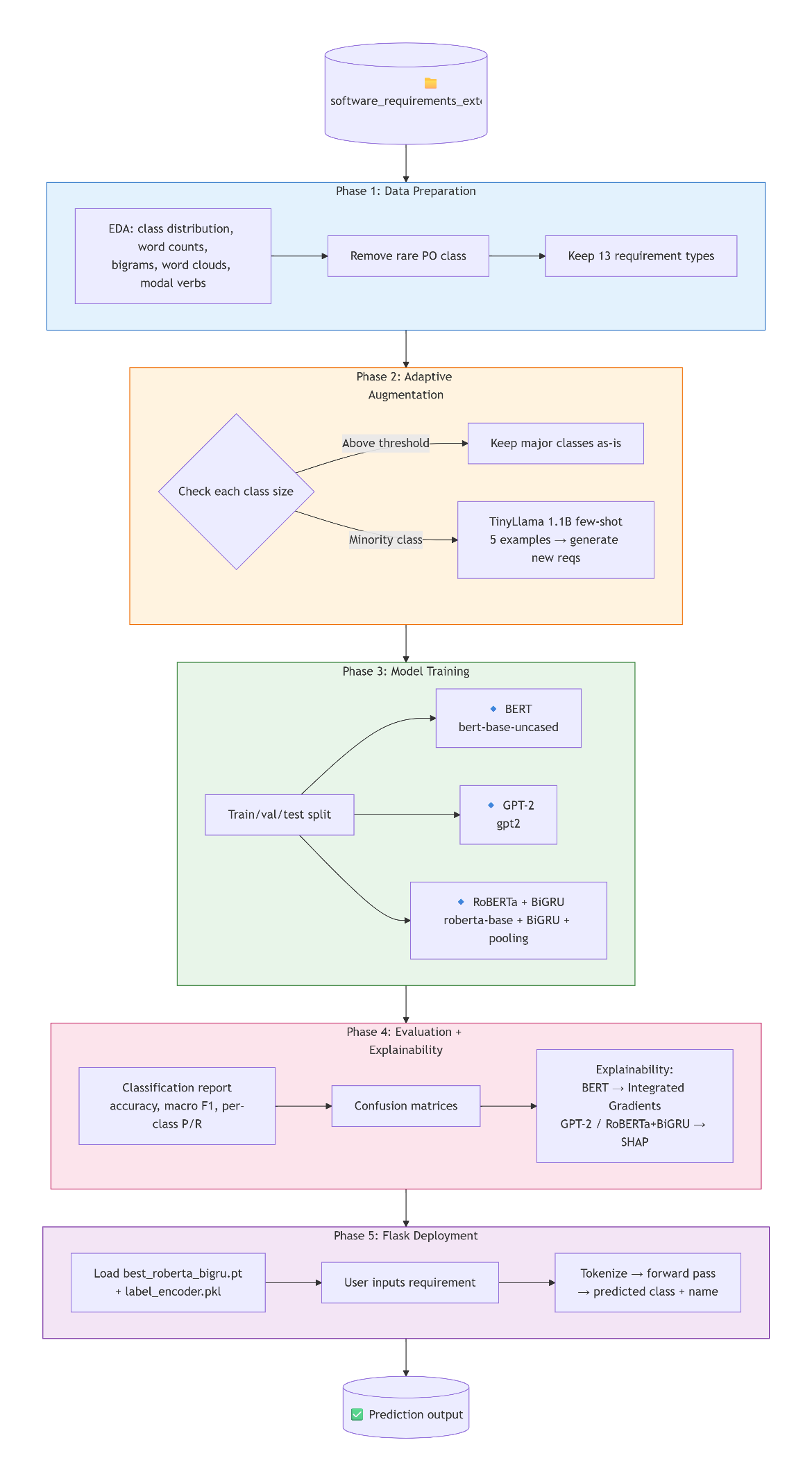
Software requirements classification is a critical yet time-consuming task in requirements engineering. Existing datasets suffer from severe class imbalance, degrading classifier performance on minority requirement types. This paper proposes an adaptive data augmentation framework that leverages TinyLlama 1.1B, a lightweight large language model, to generate synthetic requirements for underrepresented classes using few-shot prompting, balancing all 13 requirement types to a uniform target size. Three deep learning models are fine‑tuned and evaluated on the augmented dataset: BERT (bert‑base‑uncased), GPT‑2, and a novel hybrid RoBERTa + BiGRU architecture that combines RoBERTa contextual embeddings with a two‑layer bidirectional GRU and masked mean pooling for enhanced sequential representation. All models are assessed using accuracy, macro F1‑score, per‑class precision and recall, and confusion matrices. Explainability is provided through Layer Integrated Gradients for BERT and SHAP force plots for GPT‑2 and RoBERTa + BiGRU, making predictions interpretable. The best‑performing model is deployed as a local Flask web application enabling real‑time requirement classification. Experimental results demonstrate that adaptive augmentation significantly improves classification performance across all minority requirement categories.
Keywords: software requirements classification, data augmentation, TinyLlama, BERT, GPT‑2, RoBERTa, bidirectional GRU, natural language processing, deep learning, SHAP, explainability, requirements engineering
NOTE: Without the concern of our team, please don't submit to the college. This Abstract varies based on student requirements.
Block Diagram
Specifications
1. SOFTWARE REQUIREMENS
Operating System : Windows 7/8/10
Server-side Script : HTML, CSS, Bootstrap & JS
Programming Language : Python
Libraries : Flask, Pandas, Sklearn,Pytorch, NumPy, Seaborn, Matplotlib,pillow, Torch
Transformer, Torch , Shap
IDE/Workbench : VSCode
Technology : Python 3.8+
Server Deployment : Xampp Server
Database : MySQL
2. HARDWARE REQUIREMENTS
Processor - I5/Intel Processor
RAM - 8GB+ (min)
Hard Disk - 128 GB+
Key Board - Standard Windows Keyboard
Mouse - Two or Three Button Mouse
Monitor - Any


Related Projects
 Paper Publishing

Request Call Back
Would you like to receive a free callback now?
Choose the best time for callback:
Leave your message and we will contact you as soon as possible

6-2-85/B, Old Maternity Hospital Road, Thyagaraja Nagar, Tirupati, Andhra Pradesh – 517501
+91 9030333433
+91 9393939065
0877-2261612

Disclaimer - Takeoff Edu Group Projects are not associated or affiliated with IEEE in any way. The IEEE Projects mentioned here are mentioned in the context of student projects, whose ideas are derived from IEEE publications, not projects of or by IEEE.

