Activity Recognition Driver
Objective
“Activity Recognition Driver" project is to develop a system or application that can accurately and autonomously recognize various activities or actions performed by a driver while they are driving a vehicle. The primary goal is to enhance safety, provide insights, and potentially improve the overall driving experience. This project involves utilizing sensor data and advanced machine learning techniques to classify and predict different activities that a driver might engage in while driving
Abstract
Driver distraction is a leading cause of traffic accidents worldwide. This study focuses on enhancing driver behavior recognition by employing advanced deep learning architectures: DenseNet, MobileNet, and Convolutional Neural Networks (CNNs). These architectures are investigated for their potential to accurately identify distracted driving behaviors, ultimately contributing to improved road safety.
Driver distraction, involving activities like texting or eating, poses serious risks on the road. As vehicle numbers increase, mitigating distracted driving becomes crucial. In response, this research employs cutting-edge deep learning techniques to enhance the identification of such behaviors.
DenseNet, known for its densely connected layers, MobileNet, recognized for its lightweight design, and traditional CNNs are studied. These architectures are evaluated using diverse datasets, considering various scenarios and behaviors. The findings emphasize dataset quality's impact on model generalization. Moreover, a correlation is observed between network depth and accuracy, favoring deeper models.
The performance of these architectures is assessed using metrics like precision, recall, and F1-score, shedding light on their capabilities in diverse scenarios. This study's insights can guide the development of applications aimed at curbing accidents due to driver distraction, promoting safer roads.
Keywords: Driver distraction, deep learning, DenseNet, MobileNet, Convolutional Neural Networks, behavior recognition, road safety, traffic accidents, distracted driving behaviors, densenet, mobilenet and cnn.
NOTE: Without the concern of our team, please don't submit to the college. This Abstract varies based on student requirements.
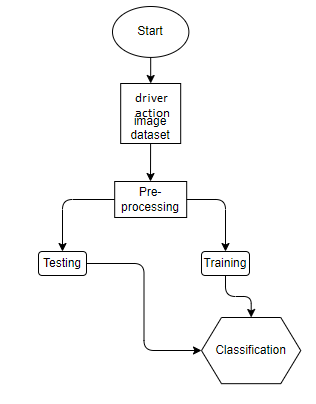
Block Diagram
Specifications
H/W Specifications:
Processor : I5/Intel Processor
RAM : 8GB (min)
Hard Disk : 128 GB
S/W Specifications:
Operating System : Windows 10
Server-side Script : Python 3.6
IDE : PyCharm, Jupyter notebook
Libraries Used : Numpy, IO, OS, Keras, pandas, tensorflow


Related Projects
 Paper Publishing

Request Call Back
Would you like to receive a free callback now?
Choose the best time for callback:
Leave your message and we will contact you as soon as possible

6-2-85/B, Old Maternity Hospital Road, Thyagaraja Nagar, Tirupati, Andhra Pradesh – 517501
+91 9030333433
+91 9393939065
0877-2261612

Disclaimer - Takeoff Edu Group Projects are not associated or affiliated with IEEE in any way. The IEEE Projects mentioned here are mentioned in the context of student projects, whose ideas are derived from IEEE publications, not projects of or by IEEE.

