A Semi-Supervised Learning Approach To Quality-Based Web Service Classification
Objective
To develop a semi-supervised learning framework that accurately classifies web services into quality-based categories, enhancing the overall classification performance and scalability of the system.
Abstract
In this study, we propose a semi-supervised learning approach for quality-based classification of web services. The increasing volume and diversity of web services necessitate effective methods for automatically categorizing and assessing their quality attributes. Our approach leverages both labeled and unlabeled data, utilizing the labeled data to guide the classification process and the unlabeled data to enhance model generalization. Specifically, we employ a combination of clustering techniques and semi-supervised learning algorithms to assign quality labels to web services based on their functional and non-functional characteristics. Through experiments conducted on a real-world dataset of web services, we demonstrate the effectiveness of our approach in improving classification accuracy and robustness compared to traditional supervised methods. The results indicate that our semi-supervised learning framework not only achieves higher classification performance but also adapts well to varying data distributions and levels of labeled data availability, making it a promising approach for enhancing the automated classification of web services based on quality criteria.
Keywords:
Semi-supervised learning, Web services, Quality-based classification, Unlabeled data, Classification accuracy, Robustness, Data distribution
NOTE: Without the concern of our team, please don't submit to the college. This Abstract varies based on student requirements.
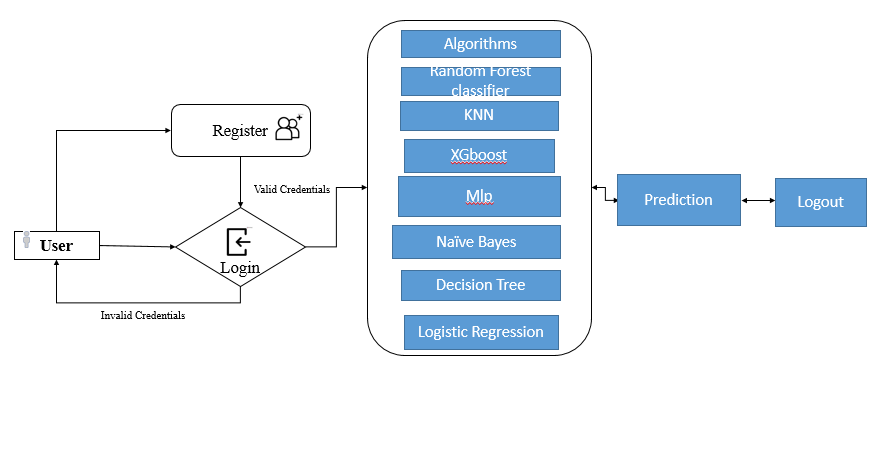
Block Diagram
Specifications
H/W CONFIGURATION:
Processor - I3/Intel Processor
Hard Disk - 160GB
Key Board - Standard Windows Keyboard
Mouse - Two or Three Button Mouse
Monitor - SVGA
RAM - 8GB
S/W CONFIGURATION:
• Operating System : Windows 7/8/10
• Server side Script : HTML, CSS, Bootstrap & JS
• Programming Language : Python
• Libraries : Flask, Pandas, Mysql.connector, Os, Scikit-learn, Numpy
• IDE/Workbench : PyCharm
• Technology : Python 3.6+
• Server Deployment : Xampp Server

Demo Video


Request for Video
Related Projects
 Paper Publishing
Request Call Back
Would you like to receive a free callback now?
Choose the best time for callback:
Leave your message and we will contact you as soon as possible

6-2-85/B, Old Maternity Hospital Road, Thyagaraja Nagar, Tirupati, Andhra Pradesh – 517501
+91 9030333433
+91 9393939065
0877-2261612

Disclaimer - Takeoff Edu Group Projects are not associated or affiliated with IEEE in any way. The IEEE Projects mentioned here are mentioned in the context of student projects, whose ideas are derived from IEEE publications, not projects of or by IEEE.

