A Blockchain Based Efficient Data Integrity Verification Scheme in Multi-Cloud Storage
Objective
The main objective of the Lost & Found Hub is to create an automated, secure, and transparent platform that connects lost items with their rightful owners quickly and efficiently. The system aims to simplify the reporting, uploading, and claiming processes by allowing users to easily add item details, images, and verification questions. It enables users who have lost items to search listings and attempt verification questions to prove ownership. Another key objective is to empower admins with tools to validate user submissions, monitor claims, and ensure all interactions maintain integrity. The system is designed to reduce fraud, increase recovery rates, and provide a structured database for tracking lost and found items. Additional goals include promoting digital responsibility, minimizing administrative workload, offering a user-friendly interface, and supporting real-time decision-making. Ultimately, the project aims to ensure fast and secure item recovery through technology-driven methods.
Abstract
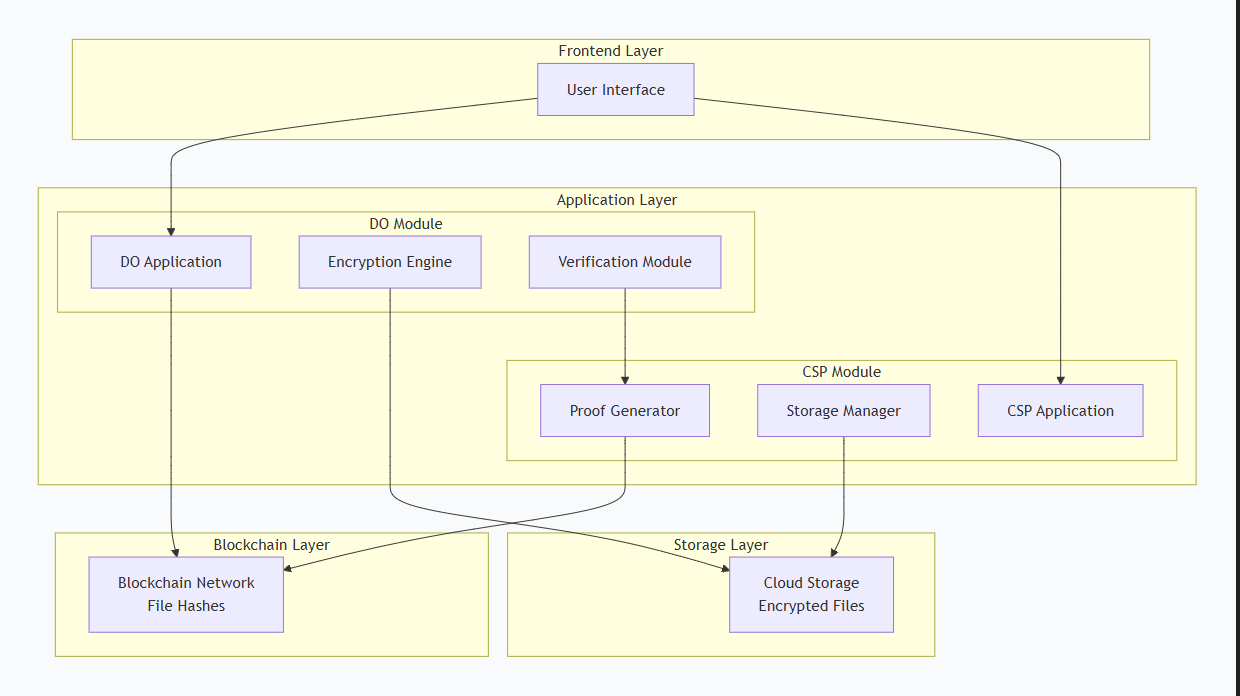
Cloud storage has become essential for data management, yet ensuring data integrity across multiple Cloud Service Providers (CSPs) remains challenging due to potential data corruption, unauthorized modifications, or service failures. Traditional verification methods rely on Third-Party Auditors (TPAs), introducing trust issues, single points of failure, and high computational overhead. This project proposes a blockchain-based data integrity verification scheme for multi-cloud storage that eliminates the need for a TPA. The system employs AES and RSA encryption for secure file uploads, stores cryptographic hashes on a private Ethereum blockchain (using Ganache and Truffle), and performs both overall and local verification to detect and localize corrupted CSPs efficiently. Smart contracts automate verification, ensuring transparency and immutability. The solution achieves high efficiency by reducing on-chain computation while maintaining security through cryptographic techniques. Experimental results demonstrate improved performance compared to traditional blockchain methods, making it suitable for practical multi-cloud environments. The system supports two roles: Data Owners (DOs) for file upload/verification and CSPs for storage management and user approval.
Keywords: Blockchain, Multi-Cloud Storage, Data Integrity Verification, AES-RSA Encryption, Smart Contracts, Ganache, Truffle, Third-Party Auditor Elimination, Local Verification, Cloud Security.
NOTE: Without the concern of our team, please don't submit to the college. This Abstract varies based on student requirements.
Block Diagram
Specifications
HARDWARE REQUIREMENTS:
· Processor - I3/Intel Processor
· Hard Disk - 160GB
· Key Board - Standard Windows Keyboard
· Mouse - Two or Three Button Mouse
· Monitor - SVGA
· RAM - 8GB
SOFTWARE SYSTEM CONFIGURATION:
· Operating System : Windows 7/8/10
· Server side Script : React.js
· Programming Language : Python
· Libraries : Django
· IDE/Workbench : VS Code
· Technology : Python 3.6+


Related Projects
 Paper Publishing

Request Call Back
Would you like to receive a free callback now?
Choose the best time for callback:
Leave your message and we will contact you as soon as possible

6-2-85/B, Old Maternity Hospital Road, Thyagaraja Nagar, Tirupati, Andhra Pradesh – 517501
+91 9030333433
+91 9393939065
0877-2261612

Disclaimer - Takeoff Edu Group Projects are not associated or affiliated with IEEE in any way. The IEEE Projects mentioned here are mentioned in the context of student projects, whose ideas are derived from IEEE publications, not projects of or by IEEE.

