Zigbee Based Real Time Earthquake Monitoring and Alert System Using IoT
Objective
The main objective is to detect earthquakes in real-time and provide immediate alerts using IoT and Zigbee communication. The project is done by using vibration or accelerometer sensors to sense seismic activity, Arduino for data processing, and Zigbee modules to transmit alerts to monitoring stations or mobile devices instantly.
Abstract
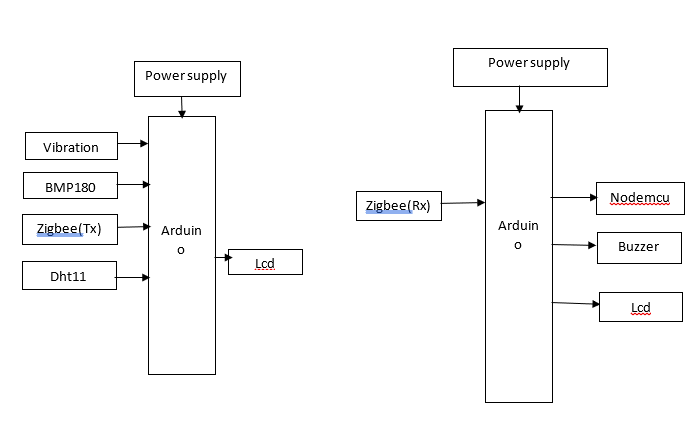
The Zigbee Based Real-Time Earthquake Monitoring and Alert System Using IoT is an advanced early warning and environmental monitoring system designed to detect seismic vibrations and provide timely alerts while continuously tracking environmental parameters. The system uses an Arduino microcontroller as the central controller to interface with various sensors, including a vibration sensor to detect tremors, a DHT11 sensor to measure temperature and humidity, and a BMP180 sensor to measure atmospheric pressure. A Zigbee module is used to establish wireless communication between transmitter and receiver units, enabling dual communication for reliable real-time data transmission across nodes. The collected data is displayed on an LCD for local monitoring and simultaneously transmitted to a NodeMCU module, which uploads it to an IoT cloud platform for remote access and data analysis. In the event of abnormal vibration levels, the system triggers a buzzer alarm to alert users and sends emergency notifications via the IoT network. A regulated power supply unit provides stable power to all components, ensuring continuous and dependable operation. This system offers a cost-effective, energy-efficient, and scalable solution for early earthquake detection and environmental monitoring, suitable for deployment in both urban and rural regions to enhance safety and disaster preparedness.
NOTE: Without the concern of our team, please don't submit to the college. This Abstract varies based on student requirements.
Block Diagram
Specifications
Hardware components:
Arduino – 2
Lcd -2
Zigbee – 2
Dht11 sensor
Bmp180 sensor
Vibration sensor
Nodemcu
Buzzer
Power supply -2
Software components:
Arduino ide
Embedded c


 Paper Publishing

Request Call Back
Would you like to receive a free callback now?
Choose the best time for callback:
Leave your message and we will contact you as soon as possible

6-2-85/B, Old Maternity Hospital Road, Thyagaraja Nagar, Tirupati, Andhra Pradesh – 517501
+91 9030333433
+91 9393939065
0877-2261612

Disclaimer - Takeoff Edu Group Projects are not associated or affiliated with IEEE in any way. The IEEE Projects mentioned here are mentioned in the context of student projects, whose ideas are derived from IEEE publications, not projects of or by IEEE.

