XAI-Enhanced Machine Learning for Obesity Risk Classification: A Stacking Approach With LIME Explanations.
Objective
To develop an enhanced machine learning framework for obesity risk classification using a stacking ensemble approach. To integrate multiple machine learning models (SVM, GBM, and CatBoost, stacking ) to improve classification accuracy and robustness.To utilize LIME (Local Interpretable Model-agnostic Explanations) to enhance model interpretability and explainability.To evaluate the performance of the ensemble model and compare it with individual models.To classify individuals into seven obesity risk categories: Normal_Weight, Overweight_Level_I, Overweight_Level_II, Obesity_Type_I, Obesity_Type_II, Obesity_Type_III, and Insufficient_Weight .To provide actionable insights for healthcare practitioners to tailor interventions based on the model’s predictions.To deploy the model through an interactive web-based platform for user-friendly access to obesity risk predictions and explanations.
Abstract
Obesity is a growing global health concern, significantly increasing the risk of various chronic diseases. Early detection and classification of obesity risk are crucial for effective prevention and management. This project presents a machine learning approach for obesity risk classification, employing a stacking method with multiple algorithms: Support Vector Machine (SVM), Gradient Boosting Machine (GBM), and CatBoost. The system classifies individuals into seven distinct obesity risk categories: Normal Weight, Overweight Level I, Overweight Level II, Obesity Type I, Obesity Type II, Obesity Type III, and Insufficient Weight. By combining the strengths of these algorithms in a stacked ensemble model, the system aims to improve classification accuracy and robustness. The models are trained and evaluated using Python, with libraries such as scikit-learn, CatBoost, and other machine learning tools. The project provides a reliable solution for obesity risk classification, contributing to personalized healthcare and early intervention strategies.
Keywords: Obesity Risk Classification, Stacking Ensemble, SVM, GBM, CatBoost, Machine Learning, Healthcare, Predictive Modeling, Data Science, Python.
NOTE: Without the concern of our team, please don't submit to the college. This Abstract varies based on student requirements.
Block Diagram
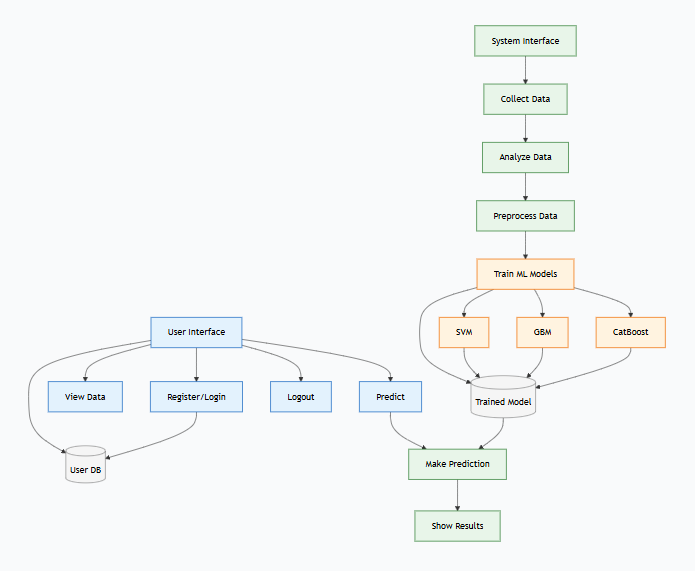
Specifications
SOFTWARE REQUIREMENS
Operating System : Windows 7/8/10
Server-side Script : HTML, CSS, Bootstrap & JS
Programming Language : Python
Libraries : Flask, Pandas, , Sklearn, Matplotlib,plotly
NumPy, Seaborn
IDE/Workbench : VSCode
Technology : Python 3.8+
Server Deployment : Xampp Server
Database : MySQL
HARDWARE REQUIREMENTS
Processor - I5/Intel Processor
RAM - 8GB +(min)
Hard Disk - 128 +GB
Key Board - Standard Windows Keyboard
Mouse - Two or Three Button Mouse
Monitor - Any


 Paper Publishing

Request Call Back
Would you like to receive a free callback now?
Choose the best time for callback:
Leave your message and we will contact you as soon as possible

6-2-85/B, Old Maternity Hospital Road, Thyagaraja Nagar, Tirupati, Andhra Pradesh – 517501
+91 9030333433
+91 9393939065
0877-2261612

Disclaimer - Takeoff Edu Group Projects are not associated or affiliated with IEEE in any way. The IEEE Projects mentioned here are mentioned in the context of student projects, whose ideas are derived from IEEE publications, not projects of or by IEEE.

