WSN Based Mountain Climber Health & GPS Tracker
Objective
The main objective of this project is to track the location and health condition of Mountain climber
Abstract
Advanced wearable biosensors for vital-signs monitoring (physiologic cipher) are available to improve quality of healthcare in hospital, nursing home, and remote environments. The objective of this study was to determine reliability of vital-signs monitoring systems in extreme environments. Main outcome measures (location, heart rate, skin temperature, core body temperature, and activity level) all correlated through timestamped identification. Climbers were monitored continuously in real-time from Mount Everest to Yale University for more than 45 minutes. Heart rate varied from 76 to 164 beats per minute, skin temperature varied from 5 to 10°C, and core body temperature varied only 1–3°C. No direct correlation was observed among heart rate, activity level, and body temperature, though numerous periods suggested intense and arduous activity. Field testing in the extreme environment of Mount Everest demonstrated an ability to track in real time both vital signs and position of climbers. However, these systems must be more reliable and robust. As technology transitions to commercial products, benefits of remote monitoring will become available for routine healthcare purposes.
Keywords: Heartbeat sensor, GPS, arduino, push buttons, Buzzer, GSM
NOTE: Without the concern of our team, please don't submit to the college. This Abstract varies based on student requirements.
Block Diagram
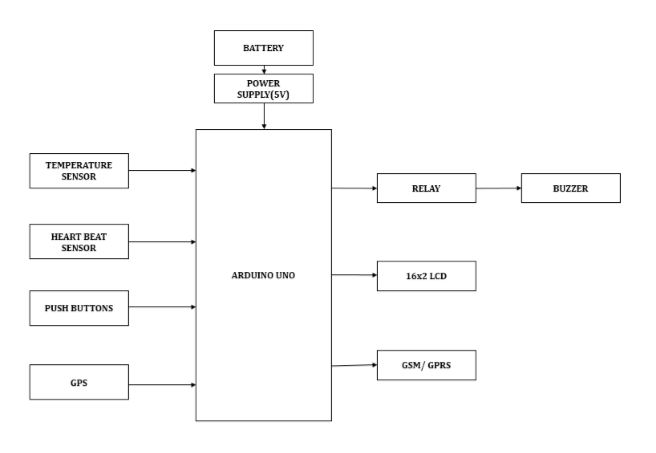
Specifications
Hardware Requirements:
- Arduino UNO
- 5v Power supply
- Battery
- Temperature sensor
- Heartbeat sensor
- GSM Module
- GPS Module
- Push buttons
- Relay
- Buzzer
- 16x2 LCD
Software Requirements:
- Arduino IDE
- Embedded C
- Fritzing
- Third Party
Learning Outcomes
- Arduino Pin diagram
- Arduino Architecture
- How to install Arduino Software
- How to interface a push button with an Arduino?
- Working of temperature sensor
- How to interface temperature sensor with Arduino?
- Working of heart beat sensor
- How to interface heart beat sensor with Arduino?
- Working of relay
- How to interface relay and buzzer with Arduino?
- Working of 16x2 LCD
- How to interface 16x2 LCD with Arduino?
- What is serial communication?
- Working of GPRS and GPS Modules
- How to interface GPRS with Arduino?
- How to interface GPS with Arduino?
- Introduction to IOT
- IOT architecture and its scope
- How to send information to an IOT platform through GPRS using arduino uno?
- About Project Development Life Cycle:
- Planning and Requirement Gathering( software’s, Tools, Hardware components, etc.,)
- Schematic preparation
- Code development and debugging
- Hardware development and debugging
- Development of the Project and Output testing
- Practical exposure to:
- Hardware and software tools. ,
- Solution providing for real time problems,
- Working with team/ individual,
- Work on Creative ideas.
- Project development Skills
- Problem analyzing skills
- Problem solving skills
- Creativity and imaginary skills
- Programming skills
- Deployment
- Testing skills
- Debugging skills
- Project presentation skills
- Thesis writing skills


 Paper Publishing

Request Call Back
Would you like to receive a free callback now?
Choose the best time for callback:
Leave your message and we will contact you as soon as possible

6-2-85/B, Old Maternity Hospital Road, Thyagaraja Nagar, Tirupati, Andhra Pradesh – 517501
+91 9030333433
+91 9393939065
0877-2261612

Disclaimer - Takeoff Edu Group Projects are not associated or affiliated with IEEE in any way. The IEEE Projects mentioned here are mentioned in the context of student projects, whose ideas are derived from IEEE publications, not projects of or by IEEE.

