works against adversarial domain name system tunnuling attacks using hybrid neural networks
Objective
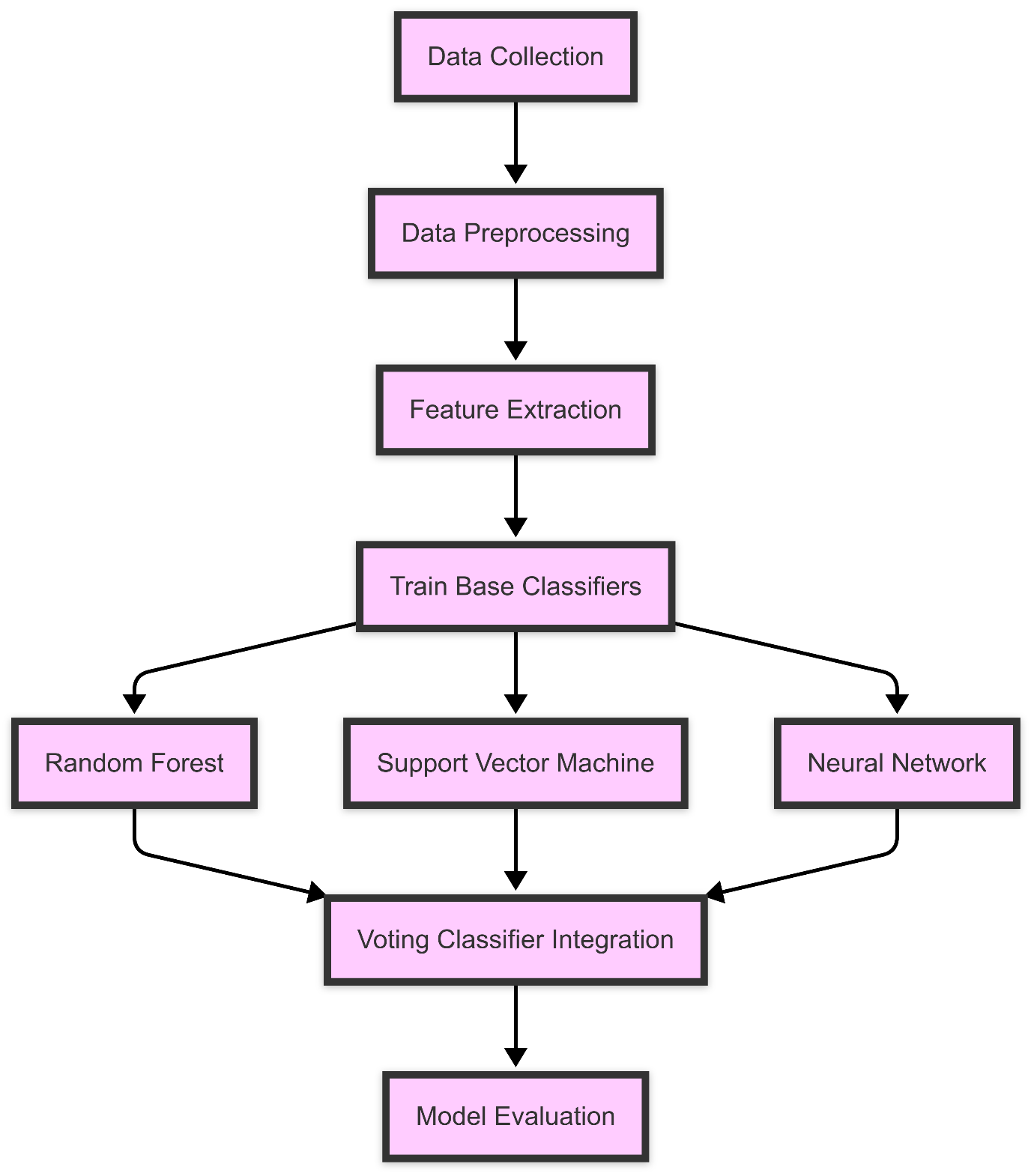
The main purpose of the study is to design a viable machine-learning method for DNS tunneling attacks within network traffic detection. Specifically, a hybrid neural-network model will be implemented using the Voting Classifier that combines several base classifiers to achieve higher accuracy and robustness. Taking advantage of the dataset FGSM_combined.csv, containing adversarial and legitimate DNS traffic, the aim is to boost DNS tunneling attack detection, reduce false positives, and ensure a trustworthy real-time detection system that can protect network infrastructure against advanced adversarial strategies
Abstract
The increasing prevalence of adversarial attacks targeting Domain Name System (DNS) infrastructures has raised significant concerns regarding network security. DNS tunneling, a technique exploited by attackers to bypass security mechanisms, can potentially lead to unauthorized data exfiltration and network compromise. This study proposes a novel approach to secure networks against adversarial DNS tunneling attacks using a hybrid neural network model, specifically a Voting Classifier, which combines the predictions of multiple base classifiers to improve attack detection accuracy. The model is trained on the FGSM_combined.csv dataset, which includes both adversarial and non-adversarial DNS traffic, sourced from the Kaggle "Adversarial Machine Learning" dataset. By leveraging the strengths of ensemble learning techniques and deep learning models, the proposed hybrid approach achieves enhanced robustness and performance in identifying DNS tunneling attempts. Experimental results demonstrate that the Voting Classifier outperforms individual machine learning models, providing a promising solution for real-time detection and mitigation of DNS tunneling attacks, thereby contributing to the strengthening of network security frameworks.
Keywords: Adversarial regional attacks, DNS tunneling, network security, hybrid neural network models, voting classifier, ensemble learning, deep learning, intrusion detection, adversarial machine learning, data exfiltration, RTD mechanism, and security mechanism.
NOTE: Without the concern of our team, please don't submit to the college. This Abstract varies based on student requirements.
Block Diagram
Specifications
4.1 SOFTWARE REQUIREMENS
Operating System : Windows 7/8/10
Server side Script : HTML, CSS, Bootstrap & JS
Programming Language : Python
Libraries :Flask, Torch, Tensorflow, Pandas, Mysql.connector
IDE/Workbench : VSCode
Server Deployment : Xampp Server
Database : MySQL
4.2 HARDWARE REQUIREMENTS
Processor - I3/Intel Processor
RAM - 8GB (min)
Hard Disk - 128 GB
Key Board - Standard Windows Keyboard
Mouse - Two or Three Button Mouse
Monitor - Any


 Paper Publishing

Request Call Back
Would you like to receive a free callback now?
Choose the best time for callback:
Leave your message and we will contact you as soon as possible

6-2-85/B, Old Maternity Hospital Road, Thyagaraja Nagar, Tirupati, Andhra Pradesh – 517501
+91 9030333433
+91 9393939065
0877-2261612

Disclaimer - Takeoff Edu Group Projects are not associated or affiliated with IEEE in any way. The IEEE Projects mentioned here are mentioned in the context of student projects, whose ideas are derived from IEEE publications, not projects of or by IEEE.

