Wireless Mobile Charging Project
Abstract
We cannot imagine the world without electric power. Generally the power is transmitted through wires. This project describes an original idea to eradicate the hazardous usage of electrical wires which involve lot of confusion in particularly organizing them. Imagine a future in which wireless power transfer is feasible: cell phones, household robots, mp3 and other portable electronics capable of charging themselves without ever being plugged in, freeing us from that final, ubiquitous power wire. Some of these devices might not even need their bulky batteries to operate. This paper includes the techniques of transmitting power without using wires with an efficiency of about 95% with non-radiative methods. Due to which it does not effect the environment surrounding. These techniques Includes resonating inductive coupling in sustainable moderate range. The coupling consists of an inductor along with a capacitor with its own resonating frequency. In any system of coupled resonators there often exists a so-called “strongly coupled” regime of operation. If one ensures to operate in that regime in a given system, the energy transfer can be very efficient. This Project as a whole gives an effective, high-performance techniques which can efficiently transmit the power to the required area varying in distances
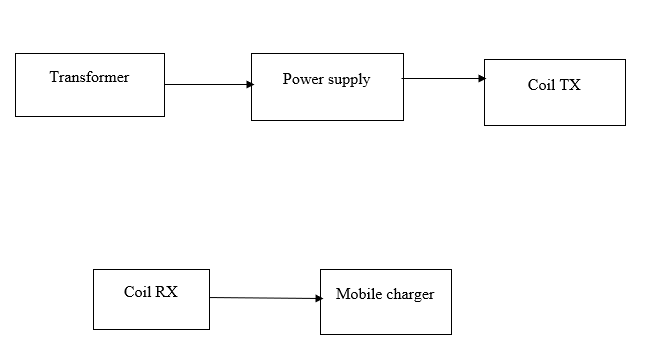
In this we are using the transmitting coil and we can connect the led to the receiver coil. Whenever we can move the receiver coil near to the transmitting coil the power will be transfer through the transmitting coil to receiver coil the led will glow using resonating inductive coupling.
Keywords: TX coil, RX coil , led and wireless transfer
NOTE: Without the concern of our team, please don't submit to the college. This Abstract varies based on student requirements.
Block Diagram
Specifications
Hardware Requirements:
- TX coil
- RX coil
- Power supply
- Jumper wires
Learning Outcomes
- Working of transmitting coil
- Working of receiver coil
- About Project Development Life Cycle:
- Planning and Requirement Gathering((Hardware components, etc.,)
- Hardware development and debugging
- Development of the Project and Output testing
- Practical exposure to:
- Hardware tools.
- Solution providing for real time problems.
- Working with team/ individual.
- Work on Creative ideas.
- Project development Skills
- Problem analyzing skills
- Problem solving skills
- Creativity and imaginary skills
- Testing skills
- presentation skills
- Thesis writing skills
Demo Video


Request for Video
 Paper Publishing
Request Call Back
Would you like to receive a free callback now?
Choose the best time for callback:
Leave your message and we will contact you as soon as possible

6-2-85/B, Old Maternity Hospital Road, Thyagaraja Nagar, Tirupati, Andhra Pradesh – 517501
+91 9030333433
+91 9393939065
0877-2261612

Disclaimer - Takeoff Edu Group Projects are not associated or affiliated with IEEE in any way. The IEEE Projects mentioned here are mentioned in the context of student projects, whose ideas are derived from IEEE publications, not projects of or by IEEE.

