Wireless Communication Technologies For Smart Grid (wams) Deployment With Raspberry Pi
Abstract
Since 2005, Smart Grid technology has revolutionized the electric power system industry. Researchers have shown a lot of interest in the opportunities offered by ICT (Information and Communication Technologies), to modernize the operation of electrical networks. This is possible by decarbonizing them as well as monitoring and controlling them with sophisticated communication standards. For this purpose, merging the technologies offered by electrical and telecommunication sector is very crucial. Various wireless communication standards viz. WiMAX, Zigbee, Bluetooth, Wi-Fi, GSM, GPRS, UMTS etc. Can be exploited to develop Smart Grid Network and extend communication throughout the distributed system. This project gives a detailed comparative study of communication protocols that can be implemented in this domain. It focuses on various aspects such as network spanning, data rates, power consumption, data security and encryption standards, data access and spread spectrum techniques, modulation and duplexing schemes for all the communication standards in Smart Grid. Hence by addressing all the critical issues, this project provides a contemporary look in the still open research areas in Smart Grid Communication.
NOTE: Without the concern of our team, please don't submit to the college. This Abstract varies based on student requirements.
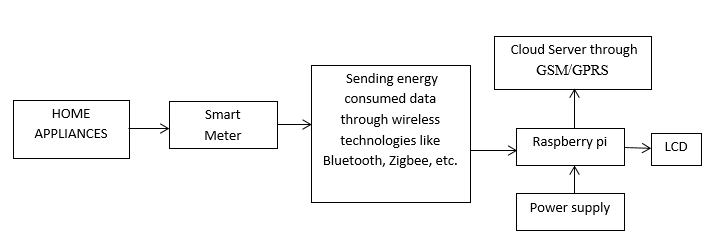
Block Diagram
Specifications
Learning Outcomes
- Raspberry pi pin diagram and architecture
- How to install Raspberry pi IDE software
- Setting up and installation procedure for Raspbian
- Basic coding in Raspbian
- Basic of python language
- Working of power supply
- Working of USB Webcamera
- Working of GSM
- Interfacing Bluetooth With Raspberry
- Working of LCD
- About Project Development Life Cycle:
- Planning and Requirement Gathering (software’s, Tools, Hardware components, etc.,)
- Schematic preparation
- Code development and debugging
- Hardware development and debugging
- Development of the Project and Output testing
- Practical exposure to:
- Hardware and software tools.
- Solution providing for real time problems.
- Working with team/ individual.
- Work on Creative ideas.
- Project development Skills
- Problem analyzing skills
- Problem solving skills
- Creativity and imaginary skills
- Programming skills
- Deployment
- Testing skills
- Debugging skills
- Project presentation skills
- Thesis writing skills


 Paper Publishing

Request Call Back
Would you like to receive a free callback now?
Choose the best time for callback:
Leave your message and we will contact you as soon as possible

6-2-85/B, Old Maternity Hospital Road, Thyagaraja Nagar, Tirupati, Andhra Pradesh – 517501
+91 9030333433
+91 9393939065
0877-2261612

Disclaimer - Takeoff Edu Group Projects are not associated or affiliated with IEEE in any way. The IEEE Projects mentioned here are mentioned in the context of student projects, whose ideas are derived from IEEE publications, not projects of or by IEEE.

