Wideband Variable-Gain Amplifiers Based on a Pseudo-Current-Steering Gain-Tuning Technique
Objective
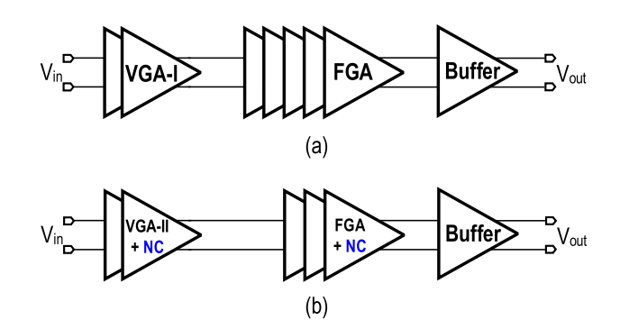
This paper reports two variable-gain amplifiers (VGAs) featuring a new pseudo-current-steering gain-tuning technique.
Abstract
This paper introduces two variable-gain amplifiers (VGAs) that incorporate an innovative pseudo-current-steering gain-tuning technique. In the first VGA, referred to as VGA-I, we have developed a standalone gain control block utilizing a single-voltage-controlled dual-branch current mirror. The second VGA, VGA-II, features the integration of two NMOS transistors, which are biased by a tunable voltage, into a conventional common-source amplifier to divert a portion of the total current. We also provide a comprehensive theoretical analysis to elucidate the mechanisms behind the different gain tuning approaches.
Both VGAs, VGA-I and VGA-II, were fabricated using a 45-nm CMOS process and demonstrate remarkable compactness. Their power consumption is also quite low, with VGA-I consuming more than VGA-II consuming. For time-domain testing, both VGA-I and VGA-II exhibit excellent performance.
NOTE: Without the concern of our team, please don't submit to the college. This Abstract varies based on student requirements.
Block Diagram
Specifications
· CADENCE VIRTUOSO
· GPDK 45
Hardware Requirements:
· Microsoft® Windows XP
· Intel® Pentium® 4 processor or Pentium 4 equivalent with SSE support
· 512 MB RAM
· 100 MB of available disk space
Learning Outcomes
o Introduction to Digital electronics
o Importance of Transistors
- MOS Fundamentals
- NMOS/PMOS/CMOS Technologies
- How to design circuits using Transistor logic?
- Scope of amplifiers in today’s world
- Applications in Real time.
- VGA importance.
o Cadence for design and simulation
o Solution providing for real time problems
- Project Development Skills:
- Problem Analysis Skills
- Problem Solving Skills
- Logical Skills
- Designing Skills
- Testing Skills
- Debugging Skills
- Presentation skills
- Thesis Writing Skills
- Cadence tool for design and simulation


 Paper Publishing

Request Call Back
Would you like to receive a free callback now?
Choose the best time for callback:
Leave your message and we will contact you as soon as possible

6-2-85/B, Old Maternity Hospital Road, Thyagaraja Nagar, Tirupati, Andhra Pradesh – 517501
+91 9030333433
+91 9393939065
0877-2261612

Disclaimer - Takeoff Edu Group Projects are not associated or affiliated with IEEE in any way. The IEEE Projects mentioned here are mentioned in the context of student projects, whose ideas are derived from IEEE publications, not projects of or by IEEE.

