Wearable Design For Infectious Disease Detection Through Machine Learning
Objective
The primary objective of this project is to design and implement a machine learning-based detection system that can analyze wearable health data and accurately predict the presence of infectious diseases such as COVID-19.
Abstract
The rapid and accurate detection of infectious diseases like COVID-19 is critical for timely intervention, especially in asymptomatic or early-stage cases. This project, titled "Wearable Design for Infectious Disease Detection Through Machine Learning," aims to leverage data from wearable health monitoring devices to develop an intelligent, automated system for detecting infectious conditions. The dataset used comprises both cross-sectional and time-series physiological signals such as body temperature, heart rate, oxygen saturation (SpO₂), respiratory rate, heart rate variability (HRV), and pulse pressure, with the target variable being a binary COVID-19 diagnosis label (0: Negative, 1: Positive).
The system integrates a variety of machine learning and deep learning models tailored for both static and sequential data. Traditional classifiers like Random Forest, Gradient Boosting, AdaBoost, and Extra Trees are employed for cross-sectional prediction, with a soft-voting ensemble strategy to enhance overall robustness and accuracy. For deep sequence modeling, Long Short-Term Memory (LSTM) networks and 1D Convolutional Neural Networks (CNNs) are utilized to capture temporal dependencies within the health signals. Additionally, Time Series Forest (TSF) is applied for modeling the temporal dynamics directly from the time-series data.
This hybrid approach allows for comprehensive pattern recognition from both static health snapshots and continuous streams of wearable data. The proposed system demonstrates high potential for real-time, non-invasive, and continuous monitoring of infectious diseases using low-cost wearable technology, promoting proactive healthcare and early-stage outbreak management.
Keywords: infectious Disease Detection, Wearable Health Monitoring, Time-Series Analysis, Cross-Sectional Modeling, Random Forest, Gradient Boosting, AdaBoost, Extra Trees Classifier, Voting Classifier, LSTM, CNN, Time Series Forest, Physiological Signal Analysis, COVID-19 Prediction, Machine Learning, Deep Learning, Biomedical Signal Processing, Health Informatics.
NOTE: Without the concern of our team, please don't submit to the college. This Abstract varies based on student requirements.
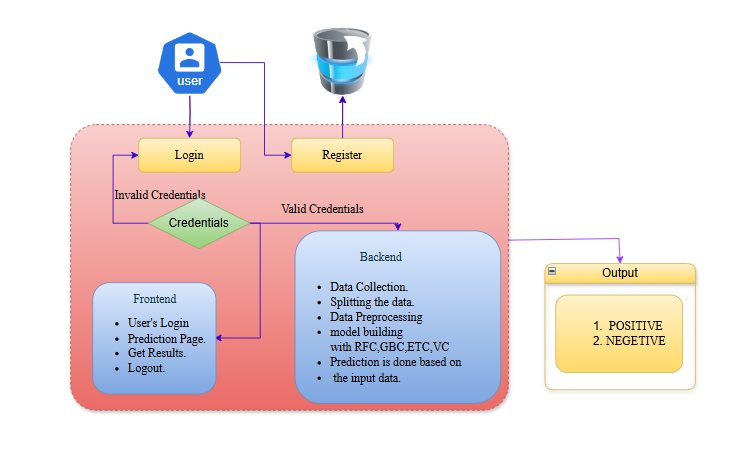
Block Diagram
Specifications
Hardware Requirements
Processor - I3/Intel Processor
Hard Disk - 160GB
Key Board - Standard Windows Keyboard
Mouse - Two or Three Button Mouse
Monitor - SVGA
RAM - 8GB
Software Requirements:
Operating System : Windows 7/8/10
Server side Script : HTML, CSS, Bootstrap & JS
Programming Language : Python
Libraries : Flask, Pandas, Mysql.connector, Os, Smtplib, Numpy
IDE/Workbench : PyCharm
Technology : Python 3.6+
Server Deployment : Xampp Server
Database : MySQL


 Paper Publishing

Request Call Back
Would you like to receive a free callback now?
Choose the best time for callback:
Leave your message and we will contact you as soon as possible

6-2-85/B, Old Maternity Hospital Road, Thyagaraja Nagar, Tirupati, Andhra Pradesh – 517501
+91 9030333433
+91 9393939065
0877-2261612

Disclaimer - Takeoff Edu Group Projects are not associated or affiliated with IEEE in any way. The IEEE Projects mentioned here are mentioned in the context of student projects, whose ideas are derived from IEEE publications, not projects of or by IEEE.

