Vulnerability Analysis on Third Party Applications
Objective
The main objective of Vulnerability Analysis on Third Party Applications is to identify and assess potential security weaknesses and vulnerabilities present in externally developed software or applications that an organization integrates into its systems. This analysis aims to proactively identify and mitigate risks associated with third-party software, ensuring the overall security and integrity of the organization's digital infrastructure.
Abstract
Malware has threatened the organizations for a long time and still have not made a lot of progress in detecting the malware on time. Malware can easily harm the system by executing the unnecessary services that will put the load on the system and hinder its smooth running. There are basically two methods to detect the malware, one being the old process of detecting the malware based on the signature and the other one being the behavior-based method. This proposed model achieved an accuracy of 91.75% during validation with 91% precision, 70% recall and for actual Malwares.
Keywords: SVM, Random forest, Decision tree, Adaboost, Xgboost, Gradient boostNOTE: Without the concern of our team, please don't submit to the college. This Abstract varies based on student requirements.
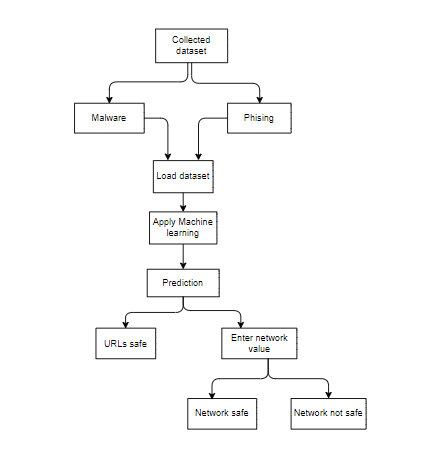
Block Diagram
Specifications
SOFTWARE FRONT END REQUIREMENTS
H/W CONFIGURATION:
Processor- I3/Intel Processor
Hard Disk- 160GB
Key Board- Standard Windows Keyboard
Mouse - Two or Three Button Mouse
Monitor - SVGA
RAM- 8GB
S/W CONFIGURATION
Operating System: Windows 7/8/10
Server side Script: HTML, CSS, Bootstrap & JS
Programming Language: Python
Libraries: Flask, Pandas, Mysql.connector, Os, Smtplib, Numpy
IDE/Workbench: PyCharm
Technology: Python 3.6+
Server Deployment: Xampp Server


 Paper Publishing

Request Call Back
Would you like to receive a free callback now?
Choose the best time for callback:
Leave your message and we will contact you as soon as possible

6-2-85/B, Old Maternity Hospital Road, Thyagaraja Nagar, Tirupati, Andhra Pradesh – 517501
+91 9030333433
+91 9393939065
0877-2261612

Disclaimer - Takeoff Edu Group Projects are not associated or affiliated with IEEE in any way. The IEEE Projects mentioned here are mentioned in the context of student projects, whose ideas are derived from IEEE publications, not projects of or by IEEE.

