VLSI Implementation of Error Detection and Correction Codes for Space Engineering
Objective
By addressing these objectives, researchers and engineers aim to create robust, efficient, and reliable VLSI implementations of error detection and correction codes specifically tailored for space engineering applications. This work contributes significantly to advancing satellite communication systems and ensuring the reliability of critical spacecraft operations.
Abstract
Abstract
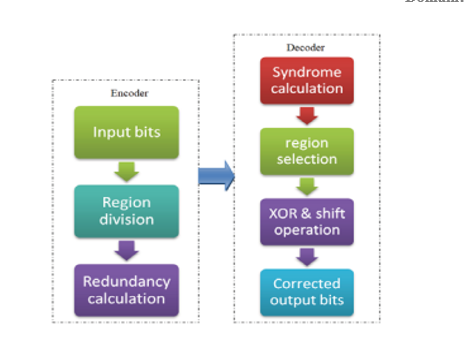
This paper presents a VLSI implementation of a novel error detection and correction scheme tailored for space engineering, targeting on-chip memory reliability in the presence of environmental factors such as cosmic radiation and extreme temperatures. The proposed 2-dimensional code utilizes a divide-symbol approach, employing XOR operations to analyze diagonal, parity, and check bits during encoding. A sophisticated decoding process involves syndrome calculation and region selection, efficiently identifying and correcting errors. Simulations using Xilinx Vivado demonstrate the scheme's effectiveness, yielding low power consumption and minimal area utilization compared to existing methods. This innovative error correction methodology offers a promising solution for enhancing memory reliability in space applications, addressing issues caused by multiple cell upsets induced by radiation.
NOTE: Without the concern of our team, please don't submit to the college. This Abstract varies based on student requirements.
Block Diagram
Specifications
Software Requirements:
· Xilinx ISE Tool/Xilinx Vivado
HDL: VerilogLearning Outcomes
Learning Outcomes:
· Basics of Digital Electronics
· Introduction to Verilog Coding
· Xilinx Vivado for design and simulation
· Learn how to extract parameters.
· Understanding Error Detection and Correction.
· Learning About XOR Operations.
· Grasping the Concept of 2-Dimensional Error Correction Code.
Demo Video


Request for Video
 Paper Publishing
Request Call Back
Would you like to receive a free callback now?
Choose the best time for callback:
Leave your message and we will contact you as soon as possible

6-2-85/B, Old Maternity Hospital Road, Thyagaraja Nagar, Tirupati, Andhra Pradesh – 517501
+91 9030333433
+91 9393939065
0877-2261612

Disclaimer - Takeoff Edu Group Projects are not associated or affiliated with IEEE in any way. The IEEE Projects mentioned here are mentioned in the context of student projects, whose ideas are derived from IEEE publications, not projects of or by IEEE.

