ViT-ResNet Fusion: An Explainable Hybrid Framework for High-Accuracy Multiclass Lung Disease Classification in Chest X-Rays
Objective
The main objective of this study is to develop a hybrid deep learning framework, ViT-ResNet Fusion, for accurate multiclass classification of lung diseases from chest X-ray images, including pneumonia, tuberculosis, COVID-19, and other pulmonary disorders. The framework aims to integrate ResNet for effective local feature extraction with Vision Transformer (ViT) for global contextual modeling, thereby leveraging the complementary strengths of both architectures. Within this framework, specialized models—PulmoFusion X, BronchoViT R, and AeroNet S—are designed to capture comprehensive pulmonary features, bronchial patterns, and subtle aeration abnormalities. Additionally, the study seeks to incorporate explainable AI techniques such as Grad-CAM to enhance interpretability, improve clinical trust, and support radiologists in timely and reliable diagnosis.
Abstract
This study introduces ViT-ResNet Fusion, a
novel hybrid deep learning framework aimed at high-accuracy multiclass lung
disease classification from chest X-ray images. Accurate identification of lung
conditions such as pneumonia, tuberculosis, COVID-19, and other pulmonary
disorders is crucial for timely clinical intervention. Traditional
convolutional neural networks (CNNs) excel at capturing local spatial features
but often fail to model global contextual relationships effectively.
Conversely, Vision Transformers (ViTs) provide superior global attention
capabilities but may underutilize fine-grained local patterns. To leverage the
complementary strengths of both architectures, we propose a fusion strategy
that integrates ResNet for robust local feature extraction with ViT for global
contextual awareness. Three specialized models are developed within this
framework: PulmoFusion‑X, which emphasizes comprehensive pulmonary
features; BronchoViT‑R, optimized for bronchial pattern recognition; and
AeroNet‑S, designed to capture subtle aeration-related abnormalities.
These models are trained and evaluated on the publicly available SIPAKM
Chest X-Ray Dataset, demonstrating substantial improvements in
classification accuracy, precision, recall, and F1-score compared to baseline
CNN and transformer models. Additionally, explainable AI techniques such as
Grad-CAM are employed to visualize the regions contributing to model
predictions, enhancing interpretability and clinical trust. The proposed hybrid
framework not only achieves state-of-the-art performance but also provides an
interpretable and scalable solution for automated chest X-ray analysis,
potentially aiding radiologists in faster and more reliable disease diagnosis.
NOTE: Without the concern of our team, please don't submit to the college. This Abstract varies based on student requirements.
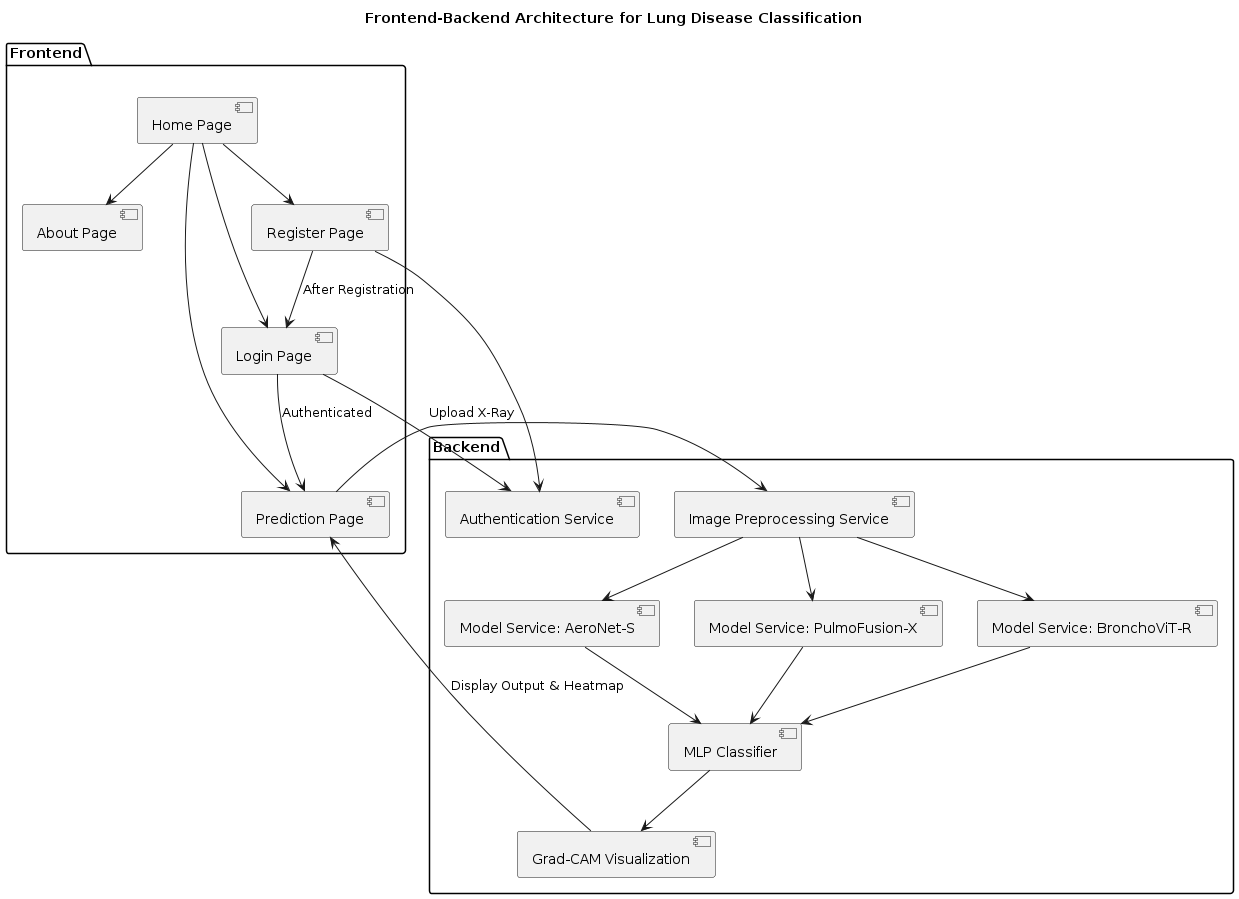
Block Diagram
Specifications
4.1 SOFTWARE REQUIREMENS
Operating System : Windows 7/8/10
Server side Script : HTML, CSS & JS
Programming Language : Python
Libraries : TensorFlow, PyTorch, NumPy, OpenCV, Matplotlib, PIL, Scikit-learn.
IDE/Workbench : VSCode
Server Deployment : MYSQL
Database : MySQL
4.2 HARDWARE REQUIREMENTS
Processor - I3/Intel Processor
RAM - 8GB (min)
Hard Disk - 128 GB
Key Board - Standard Windows Keyboard
Mouse - Two or Three Button Mouse
Monitor - Any

Demo Video


Request for Video
 Paper Publishing
Request Call Back
Would you like to receive a free callback now?
Choose the best time for callback:
Leave your message and we will contact you as soon as possible

6-2-85/B, Old Maternity Hospital Road, Thyagaraja Nagar, Tirupati, Andhra Pradesh – 517501
+91 9030333433
+91 9393939065
0877-2261612

Disclaimer - Takeoff Edu Group Projects are not associated or affiliated with IEEE in any way. The IEEE Projects mentioned here are mentioned in the context of student projects, whose ideas are derived from IEEE publications, not projects of or by IEEE.

