Virtual Eye: Object Recognition for Blind
Objective
The main objective of this project is to develop "Virtual Eye," an object recognition system for the blind using a webcam. The system will utilize the webcam to detect objects, and a speaker will verbally announce the names of detected objects in real-time, enhancing accessibility and independence for visually impaired individuals.
Abstract
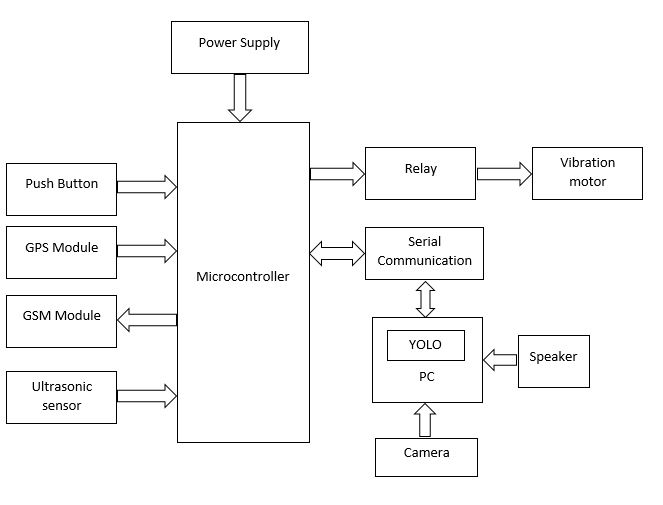
This project presents the design and implementation of a smart blind stick prototype aimed at enhancing the mobility and safety of visually impaired individuals. The Blind Stick integrates an ultrasonic sensor, GSM module, GPS module, USB web camera, speakers, and a switch, to provide object detection, alert generation, and location sharing functionalities. The prototype leverages an Arduino microcontroller to efficiently manage the sensor data and interactions.
The ultrasonic sensor is employed to detect obstacles in the user's path, triggering a buzzer alert to warn the user of potential collisions. The integration of a switch allows the user to initiate an emergency alert. Upon pressing the switch, the GSM module sends a text message containing GPS coordinates to a designated contact, facilitating rapid assistance in case of emergencies. Additionally, the Blind Stick prototype capitalizes on computer vision techniques through the utilization of the YOLO (You Only Look Once) framework. Connected to a PC, the Blind Stick leverages a USB web camera to capture images. Detected objects are then identified using YOLO, and corresponding audio alerts are relayed to the user through the earphones, enabling the user to understand their surroundings more comprehensively.
The integration of sensor and modules in the Blind Stick prototype underscores its potential to significantly enhance the independence and safety of visually impaired individuals. The obstacle detection, emergency alert system, and object recognition capabilities collectively contribute to a comprehensive and practical solution. Future work may involve refining the prototype, optimizing the object detection algorithm, and exploring additional features to further empower visually impaired users in navigating their environment.
NOTE: Without the concern of our team, please don't submit to the college. This Abstract varies based on student requirements.
Block Diagram
Specifications
Hardware Requirements:
- Arduino UNO
- Ultrasonic sensor
- GSM module
- GPS module
- Vibration motor
- USB camera
- Earphones
- Push button
- Power Supply
- LCD
Software Requirements:
- Arduino IDE
- Embedded C
Learning Outcomes
- Arduino pin diagram and architecture
- How to install Arduino IDE software
- Setting up and installation procedure for Arduino
- Introduction to Arduino IDE
- Basic coding in Arduino IDE
- Working of ultrasonic sensor and Interface with Arduino?
- Working of gps and gsm
- Interface gsm and gps with Arduino?
- Working of LCD
- Interface LCD with Arduino?
- Working of power supply
- About Project Development Life Cycle:
- Planning and Requirement Gathering (software’s, Tools, Hardware components, etc.,)
- Schematic preparation
- Code development and debugging
- Hardware development and debugging
- Development of the Project and Output testing
- Practical exposure to:
- Hardware and software tools.
- Solution providing for real time problems.
- Working with team/ individual.
- Work on Creative ideas.
- Project development Skills
- Problem analyzing skills
- Problem solving skills
- Creativity and imaginary skills
- Programming skills
- Deployment
- Testing skills
- Debugging skills
- Project presentation skills


 Paper Publishing

Request Call Back
Would you like to receive a free callback now?
Choose the best time for callback:
Leave your message and we will contact you as soon as possible

6-2-85/B, Old Maternity Hospital Road, Thyagaraja Nagar, Tirupati, Andhra Pradesh – 517501
+91 9030333433
+91 9393939065
0877-2261612

Disclaimer - Takeoff Edu Group Projects are not associated or affiliated with IEEE in any way. The IEEE Projects mentioned here are mentioned in the context of student projects, whose ideas are derived from IEEE publications, not projects of or by IEEE.

