Verification of AMBA APB Bus Protocol Using UVM
Objective
The main objective of this project is to verify the functionality of the AMBA Advanced Peripheral Bus (APB) protocol using the Universal Verification Methodology (UVM) to ensure reliable and efficient data communication between peripherals in a System-on-Chip (SoC) design. The project aims to develop a reusable, modular, and coverage-driven UVM-based verification environment to validate protocol compliance, functionality, and performance of the APB interface.
Abstract
Abstract:
The architectures should be interconnected and managed with functional blocks. Ensuring the correct implementation and functionality of the AMBA protocol is crucial for the reliability and performance of SoC devices. This paper presents a verification methodology for the AMBA APB bus protocol using (UVM). Our verification approach involves developing a UVM based testbench that models the AMBA APB bus protocol and generates directed and constrained-random transactions to exercise the design under test (DUT). System Verilog has various components through which the transaction is driven to DUT and capture the outputs. The drivers that initiate transactions, monitors observe bus activity and scoreboards check protocol compliance and data integrity. We implemented a comprehensive set of tests that cover various scenarios, including read and write transactions, single transfers, different data sizes, and error conditions.NOTE: Without the concern of our team, please don't submit to the college. This Abstract varies based on student requirements.
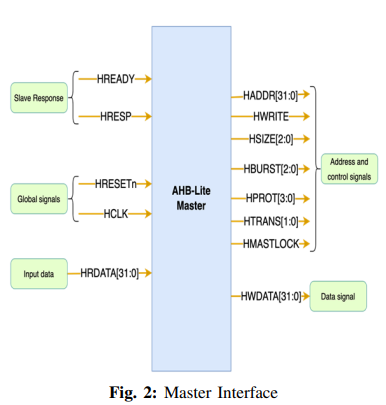
Block Diagram
Specifications
Software Requirements:
· Xilinx ISE14.7 Suite/Vivado2018.3 Tool.
· HDL: Verilog.
Hardware Requirements:
· Microsoft® Windows XP.
· Intel® Pentium® 4 processor or Pentium 4 equivalent with SSE support.
· 512 MB RAM.
· 100 MB of available disk space.
Learning Outcomes
• Basics of Digital Electronics
• FPGA design Flow
• Introduction to Verilog Coding
• Different modeling styles in Verilog
o Data Flow modeling
o Structural modeling
o Behavioral modeling
o Mixed level modeling
• Drawbacks of existing methods
• Applications in real time
• Xilinx ISE 14.7/Xilinx Vivado for design and simulation
• Generation of Netlist
• Solution providing for real time problems
• Project Development Skills:
o Problem Analysis Skills
o Problem Solving Skills
o Logical Skills
o Designing Skills
o Testing Skills.
o Debugging Skills.
o Presentation Skills.
o Thesis Writing Skills
Demo Video


Request for Video
 Paper Publishing
Request Call Back
Would you like to receive a free callback now?
Choose the best time for callback:
Leave your message and we will contact you as soon as possible

6-2-85/B, Old Maternity Hospital Road, Thyagaraja Nagar, Tirupati, Andhra Pradesh – 517501
+91 9030333433
+91 9393939065
0877-2261612

Disclaimer - Takeoff Edu Group Projects are not associated or affiliated with IEEE in any way. The IEEE Projects mentioned here are mentioned in the context of student projects, whose ideas are derived from IEEE publications, not projects of or by IEEE.

