Using Convolutional Neural Network to Recognize Learning Images for Early Warning of At-Risk Students
Objective
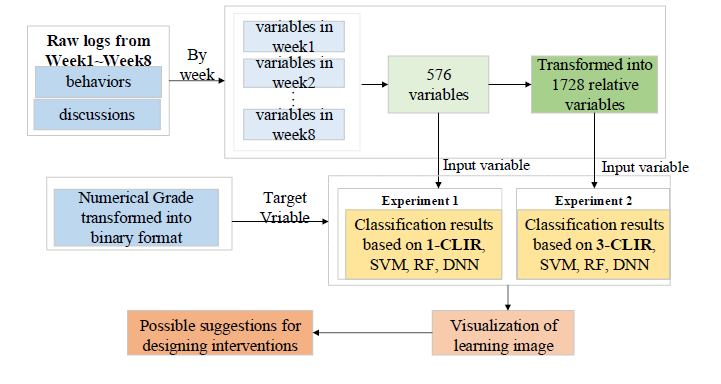
The objective is to propose two innovative approaches called “one-channel learning image recognition” (1-CLIR) and “three-channel learning image recognition” (3-CLIR) to take advantage of the advanced CNN framework to improve the predictive model’s performance.
Abstract
Instructional design is crucial in online courses and scholars have found its connections with student’s learning performance. Due to the lack of face-to-face interactions and observations in online learning, the considerations involved in the design of an effective online course can be significantly different than those in a face-to-face course, which is also why many higher education institutions provide instructional designers to support faculty members. In fact, institutions invest substantial resources aimed at supporting learners in overcoming learning obstacles associated with the characteristics of online learning environments.
The results indicate both methods can significantly capture more at-risk students (the highest average recall rate is equal to 77.26%) than the following machine learning algorithms—Support Vector Machine (SVM), Random Forest (RF), and Deep Neural Network (DNN) in the middle of the semester.
Keywords: Convolution Neural Networks, Machine Learning, Distance Learning, Image Recognition, At-Risk, Early Warning, Prediction.
NOTE: Without the concern of our team, please don't submit to the college. This Abstract varies based on student requirements.
Block Diagram
Specifications
HARDWARE SPECIFICATIONS:
- Processor- I3/Intel Processor
- RAM- 4GB (min)
- Hard Disk- 128 GB
- Key Board-Standard Window
- Keyboard. Mouse-Two or Three Button Mouse.
- Monitor-Any.
SOFTWARE SPECIFICATIONS:
- Operating System: Windows 7+
- Technology: Python 3.6+
- IDE: PyCharm IDE
- Libraries Used: Pandas, NumPy, OpenCV, TensorFlow, Matplotlib.
Learning Outcomes
- Convolutional Neural networks.
- Machine learning.
- Distance learning.
- Image recognition.
- Predictive analysis.
- Process of debugging a code.
- Input and Output modules.
- How test the project based on user inputs and observe the output.
- Project Development Skills:
- Problem analyzing skills.
- Problem solving skills.
- Creativity and imaginary skills.
- Programming skills.
- Deployment.
- Testing skills.
- Debugging skills.
- Project presentation skills.
- Thesis writing skills.


 Paper Publishing

Request Call Back
Would you like to receive a free callback now?
Choose the best time for callback:
Leave your message and we will contact you as soon as possible

6-2-85/B, Old Maternity Hospital Road, Thyagaraja Nagar, Tirupati, Andhra Pradesh – 517501
+91 9030333433
+91 9393939065
0877-2261612

Disclaimer - Takeoff Edu Group Projects are not associated or affiliated with IEEE in any way. The IEEE Projects mentioned here are mentioned in the context of student projects, whose ideas are derived from IEEE publications, not projects of or by IEEE.

