Using AI to Detect Stroke Related Facial Weakness with Limited face images
Objective
This project focuses on using artificial intelligence to detect stroke-induced facial weakness, even when only a limited number of facial images are available. Early detection of facial asymmetry is critical for timely stroke intervention, yet manual assessment can be slow and subjective. By employing AI techniques such as deep learning and image augmentation, the system can accurately identify subtle facial changes, enabling rapid and reliable screening. The model aims to assist healthcare professionals in early diagnosis, improving patient outcomes. Additionally, the project explores methods to overcome data scarcity, ensuring that the AI remains effective with minimal training data.
Abstract
Stroke is one of the leading causes of long-term disability and death worldwide, where rapid and accurate detection of early symptoms is critical for effective treatment and recovery. Among the primary indicators, facial weakness serves as a vital clinical cue in identifying stroke onset. Traditional diagnostic methods often rely on physical examination or advanced imaging, which may be time-consuming, resource-intensive, and inaccessible in remote or resource-limited areas. This project, Using AI to Detect Stroke Related Facial Weakness with Limited Face Images, proposes an artificial intelligence–driven approach to detect stroke symptoms from facial features using minimal image data. The system leverages deep learning techniques with optimized feature extraction and classification models to handle data scarcity while ensuring robust performance. By employing transfer learning with pre-trained convolutional neural networks and augmentation strategies, the framework enhances recognition accuracy under limited training conditions. The project flow includes data preprocessing, facial landmark detection, feature extraction, model training, evaluation, and deployment in a user-friendly interface for early stroke risk assessment. This AI-based system aims to provide a fast, non-invasive, and cost-effective screening tool that can support clinicians and empower telemedicine applications. Ultimately, it highlights the potential of machine learning in addressing critical healthcare challenges where medical expertise and diagnostic infrastructure are limited.
Keywords
Stroke Detection, Facial Weakness, Artificial Intelligence, Deep Learning, Limited Data, Transfer Learning, Healthcare AI, Convolutional Neural Networks, Medical Image Analysis, Early Diagnosis.
NOTE: Without the concern of our team, please don't submit to the college. This Abstract varies based on student requirements.
Block Diagram
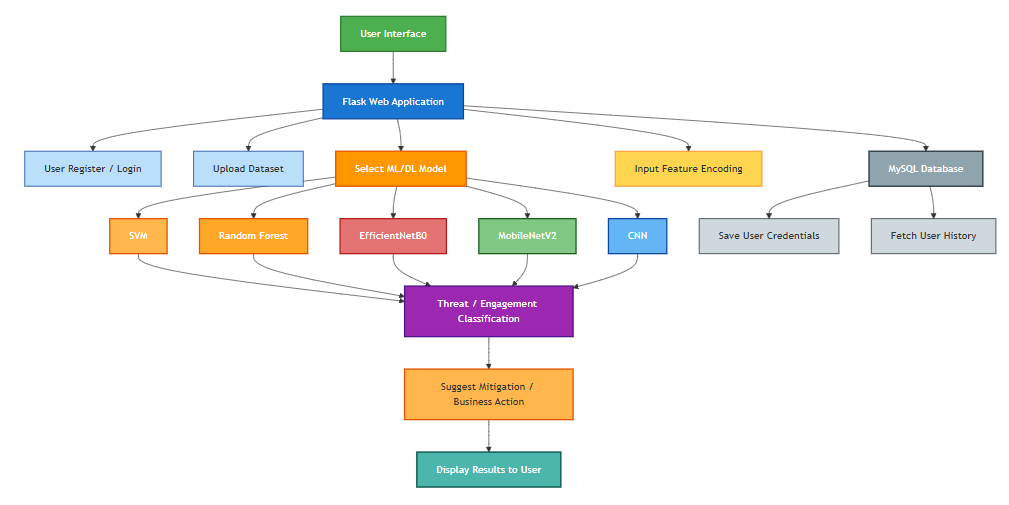
Specifications
SOFTWARE REQUIREMENS
Operating System : Windows 7/8/10
Server side Script : HTML, CSS, Bootstrap & JS
Programming Language : Python
Libraries : Flask, Pandas, Torch, Keras, Sklearn,Numpy , Seaborn
IDE/Workbench : VSCODE
Server Deployment : Xampp Server
Database : MySQL
HARDWARE REQUIREMENTS
Processor - I3/Intel Processor
RAM - 8GB (min)
Hard Disk - 128 GB
Key Board - Standard Windows Keyboard
Mouse - Two or Three Button Mouse
Monitor - Any

Demo Video


Request for Video
 Paper Publishing
Request Call Back
Would you like to receive a free callback now?
Choose the best time for callback:
Leave your message and we will contact you as soon as possible

6-2-85/B, Old Maternity Hospital Road, Thyagaraja Nagar, Tirupati, Andhra Pradesh – 517501
+91 9030333433
+91 9393939065
0877-2261612

Disclaimer - Takeoff Edu Group Projects are not associated or affiliated with IEEE in any way. The IEEE Projects mentioned here are mentioned in the context of student projects, whose ideas are derived from IEEE publications, not projects of or by IEEE.

