UPI FRAUD DETECTION USING MACHINE LEARNING
Objective
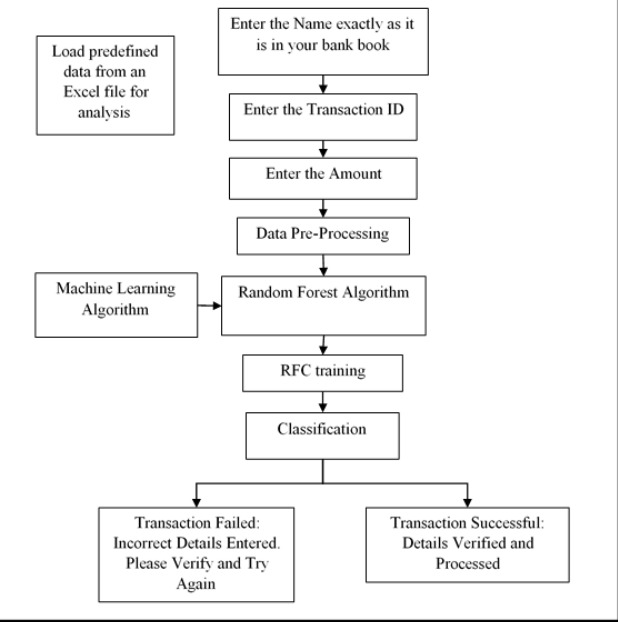
The primary objective of this project is to develop an effective fraud detection system for Unified Payments Interface (UPI) transactions by analyzing critical transaction details such as the bank book name, transaction ID, and transaction amount.
Abstract
With the rapid adoption of Unified Payments Interface (UPI) for digital transactions, the risk of fraudulent activities has also increased significantly. To address this challenge, we propose a novel approach to detect UPI fraud by analyzing transaction details such as the bank book name, transaction ID, and transaction amount. Our method employs a Random Forest classifier, a robust machine learning algorithm known for its accuracy and resilience against overfitting. The system processes the provided transaction details to classify the transaction outcome as either "Transaction Failed: Incorrect Details Entered" or "Transaction Successful: Details Verified and Processed." This classification not only helps in preventing fraudulent transactions but also ensures that legitimate transactions are processed smoothly. The proposed model aims to enhance the security of UPI transactions, providing users with an additional layer of protection against unauthorized activities. Initial evaluations suggest that the Random Forest classifier effectively distinguishes between genuine and fraudulent transactions, demonstrating its potential for integration into real-world financial systems.
Keywords: UPI Digital Payments, Random Forest Algorithm, Machine Learning.
NOTE: Without the concern of our team, please don't submit to the college. This Abstract varies based on student requirements.
Block Diagram
Specifications
H/W Specifications:
· Processor : I5/Intel Processor
· RAM : 8GB (min)
· Hard Disk : 128 GB
S/W Specifications:
• Operating System : Windows 10
• Server-side Script : Python 3.6
• IDE : PyCharm, Jupyter notebook
• Libraries Used : Numpy, IO, OS, Flask, Keras, pandas, tensorflow

Demo Video


Request for Video
 Paper Publishing
Request Call Back
Would you like to receive a free callback now?
Choose the best time for callback:
Leave your message and we will contact you as soon as possible

6-2-85/B, Old Maternity Hospital Road, Thyagaraja Nagar, Tirupati, Andhra Pradesh – 517501
+91 9030333433
+91 9393939065
0877-2261612

Disclaimer - Takeoff Edu Group Projects are not associated or affiliated with IEEE in any way. The IEEE Projects mentioned here are mentioned in the context of student projects, whose ideas are derived from IEEE publications, not projects of or by IEEE.

