Unknow Classs Classification using Deep Learning Technique
Objective
The main objective of this to classify the known (fruit) and the unknown classes which are different from the known one deep learning.
Abstract
Traditional Fruits feature extraction methods focus on spectral features and neglect spatial features, its extraction method is set in advance and is not suitable for all Fruits images. Faced with these problems, we propose a three-dimensional convolutional network for Fruits classification, which consists of a convolutional layer,2 down sampling layers, 2 identification layers, a flatten layer, and 4 fully connected layers. The proposed network employs three-dimensional convolution operation to extract spectral-spatial features from Fruits images, there are two reasons for this, the first reason is three-dimensional convolution can automatically learn a large number of mappings between input and output. The second reason is three-dimensional convolution can effectively extract spectral-spatial features and improve network classification performance. In order to extract high-level features and prevent network performance degradation, the proposed network adopts residual connections. More importantly, the OpenMax algorithm is employed to detect Fruits unknown targets. In addition to the probability that the output belongs to a known class, the OpenmMax adds the probability that the predicted input belongs to unknown classes, as a result, the deep convolutional network can respond to inputs of unknown classes. Experiments based on typical Fruits data show that the proposed network perform accurately in the known classes’ classification and the openmax algorithm is suitable for unknown targets detection of Fruits images.
Known Classes Classification And Unkown Classes Targets Detection Of
FruitsImages Based On Convolutional Neural Networks
Lixiong Zhang,Yuanxi Peng,Tian Jiang ,Yu Liu,Kecheng Gong,Lu Liu,Liyuan Zhao,Longlong Zhang
(National University of Defense and Technology,College of Computer,CHANG’sha 410073,China)
Abstract
Traditional Fruitsfeature extraction methods focus on spectral features and neglect spatial features,its extraction method
is set in advance and is not suitable for all Fruitsimages. Faced with these problems, we propose a three-dimensional
convolutional network for Fruitsclassification, which consists of a convolutional layer,2 downsampling layers, 2
identification layers, a flatten layer, and 4 fully connected layers. The proposed network employs three-dimensional convolution
operation to extract spectral-spatial features from Fruitsimages,there are two reasons for this, the first reason is
three-dimensional convolution can automatically learn a large number of mappings between input and output.The second reason is
three-dimensional convolution can effectively extract spectral-spatial features and improve network classification performance. In
order to extract high-level features and prevent network performance degradation, the proposed network adopts residual
connections.More importantly, the OpenMax algorithm is employed to detect Fruitsunknown targets. In addition to the
probability that the output belongs to a known class, the OpenmMx adds the probability that the predicted input belongs to unknown
classes, as a result,the deep convolutional network can respond to inputs of unknown classes.experiments based on typical
Fruitsdata show that the proposed network perform accurately in the known classes classification and the openmax algorithm
is suitable for unknown targets detection of Fruitsimages.
Keywords:FruitsImages ,Three-dimensional convolution, Spectral-spatial features, OpenMax,Known class
classification,Unknown classes detection,Residual connections, Extreme value theory
Known Classes Classification And Unkown Classes Targets Detection Of
FruitsImages Based On Convolutional Neural Networks
Lixiong Zhang,Yuanxi Peng,Tian Jiang ,Yu Liu,Kecheng Gong,Lu Liu,Liyuan Zhao,Longlong Zhang
(National University of Defense and Technology,College of Computer,CHANG’sha 410073,China)
Abstract
Traditional Fruitsfeature extraction methods focus on spectral features and neglect spatial features,its extraction method
is set in advance and is not suitable for all Fruitsimages. Faced with these problems, we propose a three-dimensional
convolutional network for Fruitsclassification, which consists of a convolutional layer,2 downsampling layers, 2
identification layers, a flatten layer, and 4 fully connected layers. The proposed network employs three-dimensional convolution
operation to extract spectral-spatial features from Fruitsimages,there are two reasons for this, the first reason is
three-dimensional convolution can automatically learn a large number of mappings between input and output.The second reason is
three-dimensional convolution can effectively extract spectral-spatial features and improve network classification performance. In
order to extract high-level features and prevent network performance degradation, the proposed network adopts residual
connections.More importantly, the OpenMax algorithm is employed to detect Fruitsunknown targets. In addition to the
probability that the output belongs to a known class, the OpenmMx adds the probability that the predicted input belongs to unknown
classes, as a result,the deep convolutional network can respond to inputs of unknown classes.experiments based on typical
Fruitsdata show that the proposed network perform accurately in the known classes classification and the openmax algorithm
is suitable for unknown targets detection of Fruitsimages.
Keywords:FruitsImages ,Three-dimensional convolution, Spectral-spatial features, OpenMax,Known class
classification,Unknown classes detection,Residual connections, Extreme value theory
Keywords:FruitsImages ,Three-dimensional convolution, Spectral-spatial features, OpenMax,Known class
classification,Unknown classes detection,Residual connections, Extreme value theory
NOTE: Without the concern of our team, please don't submit to the college. This Abstract varies based on student requirements.
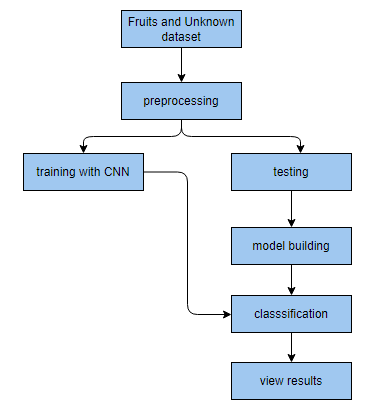
Block Diagram
Specifications
H/W Specifications:
- Processor :I5/Intel Processor
- RAM : 8GB (min)
- Hard Disk:128 GB
S/W Specifications:
- Operating System: Windows 10
- Server-side Script : Python 3.6
- IDE: PyCharm, Jupyter notebook
- Libraries Used: Numpy, IO, OS, Flask, Keras, pandas, tensorflow
Learning Outcomes
Practical exposure to
· Hardware and software tools
· Solution providing for real time problems
· Working with team/individual
· Work on creative ideas
· Testing techniques
· Error correction mechanisms
· What type of technology versions is used?
· Working of Tensor Flow
· Implementation of Deep Learning techniques
· Working of CNN algorithm
· Working of Transfer Learning methods
· Building of model creations
· Scope of project
· Applications of the project
· About Python language
· About Deep Learning Frameworks
· Use of Data Science


 Paper Publishing

Request Call Back
Would you like to receive a free callback now?
Choose the best time for callback:
Leave your message and we will contact you as soon as possible

6-2-85/B, Old Maternity Hospital Road, Thyagaraja Nagar, Tirupati, Andhra Pradesh – 517501
+91 9030333433
+91 9393939065
0877-2261612

Disclaimer - Takeoff Edu Group Projects are not associated or affiliated with IEEE in any way. The IEEE Projects mentioned here are mentioned in the context of student projects, whose ideas are derived from IEEE publications, not projects of or by IEEE.

