Two-Layer Security for Image Encryption A Switched System Approach
Objective
The primary objective of this project is to design and implement a secure two-layer image encryption system using a switched system approach to protect digital images from unauthorized access and cryptographic attacks. The project aims to apply chaos-based switching mechanisms to introduce high randomness and unpredictability during encryption, thereby enhancing security through confusion and diffusion principles. Another important objective is to develop a compact and user-friendly key management scheme using a short key array and a switching parameter, reducing key storage complexity while maintaining strong cryptographic strength.
Abstract
The proposed two-layer image encryption system leverages the concept of switched systems to dynamically alternate between multiple chaotic subsystems during the encryption process. Unlike traditional single-map chaotic encryption techniques, the switched system introduces time-varying behavior, which significantly increases randomness and makes cryptanalysis more difficult. The switching mechanism depends on pixel position and system parameters, ensuring that even minor variations in the key values produce entirely different encrypted outputs. This design improves key sensitivity and strengthens resistance against brute-force and statistical attacks.
To improve usability while maintaining security, the system adopts a compact key representation strategy. Instead of storing or sharing a large key matrix, a short array of numerical values and a single switching parameter are used to deterministically regenerate the chaotic behavior required for decryption. This approach reduces memory overhead and simplifies key handling for users, making the system suitable for practical web-based applications. Decryption is strictly controlled by verifying user-provided keys against database records, ensuring that only authorized users can recover the original image.
The system is implemented using a Django-based web framework, providing secure user authentication, session management, and role-based access control for both users and administrators. Each encrypted image is associated with a specific user, enabling secure history tracking and preventing unauthorized access to encrypted data. Experimental evaluation shows that the encrypted images exhibit uniform histograms, low adjacent pixel correlation, and high sensitivity to key variations, indicating strong security characteristics. Overall, the proposed system successfully balances security, efficiency, and usability, making it a reliable solution for secure image storage and transmission.
Keywords: Two-layer image encryption, switched system approach, chaotic encryption, image security, confusion and diffusion, key sensitivity, user authentication, access control, secure image transmission, and web-based cryptographic implementation.
NOTE: Without the concern of our team, please don't submit to the college. This Abstract varies based on student requirements.
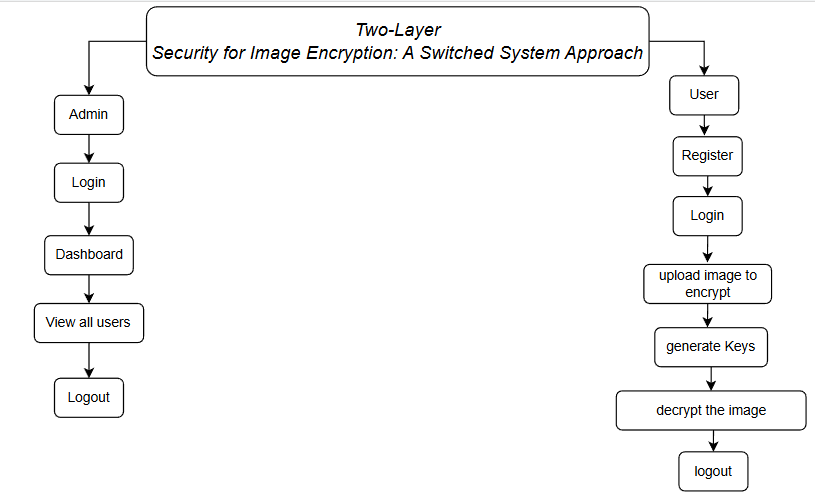
Block Diagram
Specifications
H/W CONFIGURATION:
· Processor - I3/Intel Processor
· Hard Disk -160GB
· Key Board - Standard Windows Keyboard
· Mouse - Two or Three Button Mouse
· Monitor - SVGA
· RAM - 4Gb
S/W CONFIGURATION:
· Operating System : Windows 7/8/10
· Server side Script : Python, HTML, MYSQL, CSS, Bootstrap.
· Libraries : Django, Smtlib
· IDE : VS Code
· Technology : Python 3.10+


 Paper Publishing

Request Call Back
Would you like to receive a free callback now?
Choose the best time for callback:
Leave your message and we will contact you as soon as possible

6-2-85/B, Old Maternity Hospital Road, Thyagaraja Nagar, Tirupati, Andhra Pradesh – 517501
+91 9030333433
+91 9393939065
0877-2261612

Disclaimer - Takeoff Edu Group Projects are not associated or affiliated with IEEE in any way. The IEEE Projects mentioned here are mentioned in the context of student projects, whose ideas are derived from IEEE publications, not projects of or by IEEE.

