Transformer Encoder Driven Deep Learning Network for Single Lead ECG Arrhythmia’s
Objective
Develop a robust deep learning system for single-lead ECG arrhythmia classification using FREQ-ECG-Net and QuadPillar models with preprocessed ECG images. Implement a Flask backend and interactive front-end to provide explainable, scalable arrhythmia predictions with high accuracy and user-friendly visualizations. Continuously evaluate performance using standard metrics to ensure reliable, interpretable, and clinically useful detection across multiple arrhythmia types.
Abstract
Electrocardiogram (ECG) analysis plays a crucial
role in detecting arrhythmia, a condition associated with irregular heart
rhythms that can lead to severe cardiac complications. This project introduces
a Transformer Encoder Driven Deep
Learning Network for single-lead ECG arrhythmia detection. The system
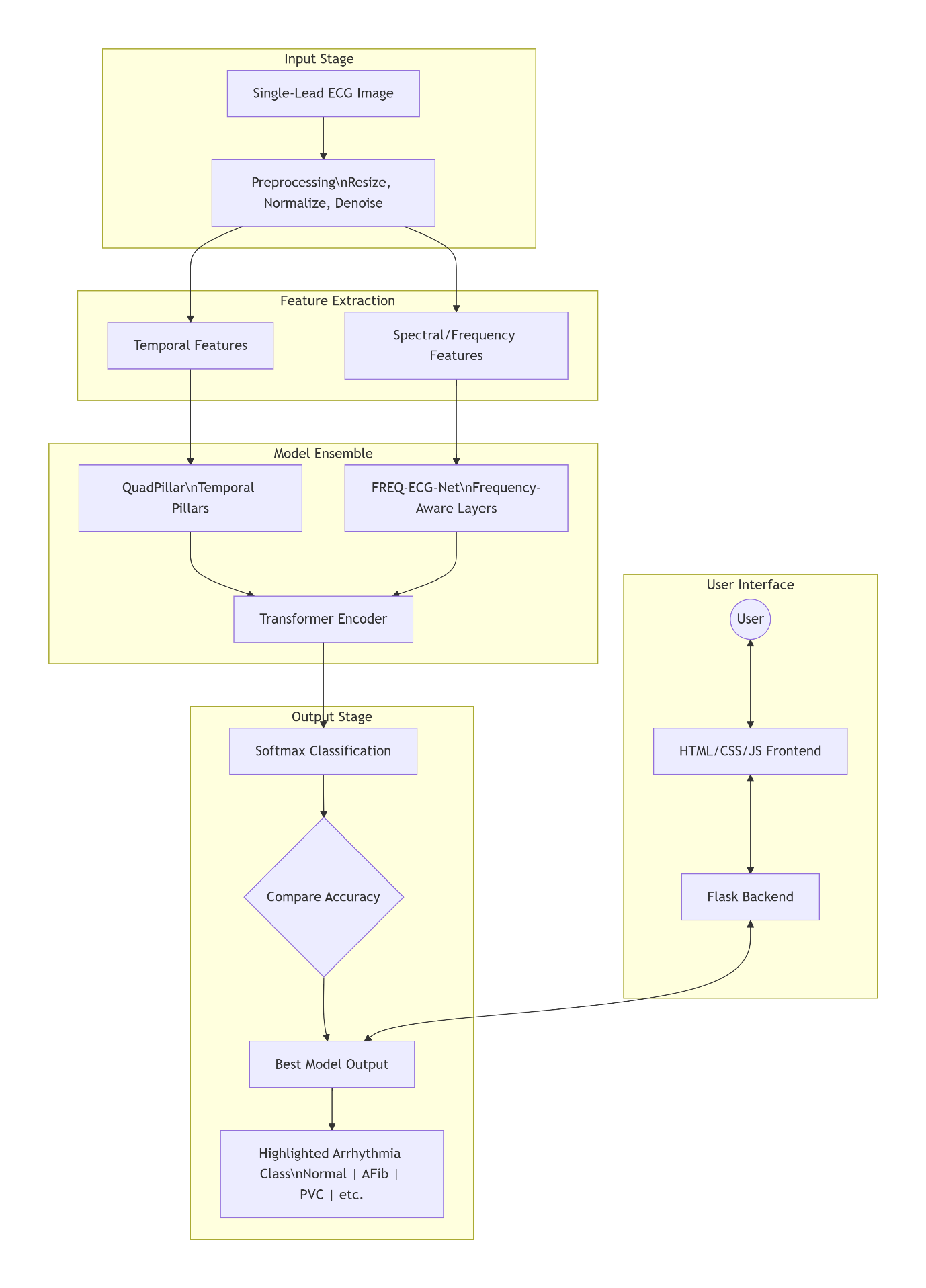
leverages FREQ-ECG-Net, a
frequency-aware deep learning network, and QuadPiltransformer encoder-driven deep learning network robust
classification of ECG signals. The model is trained and evaluated using the ECG
Images dataset from Kaggle, comprising diverse arrhythmia classes. The
architecture efficiently captures both temporal and spectral features of ECG
signals, enabling high classification accuracy. The framework is supported by a
Flask-based backend, with an interactive front-end developed using HTML, CSS,
and JavaScript. Users can register, log in, and submit ECG images for automated
classification, receiving results with highlighted arrhythmia classes.
Performance metrics, including accuracy, precision, recall, and F1-score,
demonstrate the system’s reliability. This study emphasizes explainability,
ease of use, and scalable deployment in healthcare monitoring applications.
Overall, the proposed approach offers a significant advancement in automated arrhythmia
detection, supporting clinicians in decision-making processes and reducing
diagnostic effort.
Keywords: ECG, Arrhythmia Detection, Transformer Encoder, FREQ-ECG-Net, QuadPillar, Deep Learning, Single Lead ECG, Classification, Neural Networks, Flask.
NOTE: Without the concern of our team, please don't submit to the college. This Abstract varies based on student requirements.
Block Diagram
Specifications
SOFTWARE REQUIREMENS
Operating System : Windows 7/8/10
Server side Script : HTML, CSS & JS
Programming Language : Python
Libraries : scikit-learn, pandas, numpy, matplotlib, seaborn, TensorFlow, Keras, Flask, SQLAlchemy.
IDE/Workbench : VSCode
Server Deployment : MYSQL
Database : MySQL
HARDWARE REQUIREMENTS
Processor - I3/Intel Processor
RAM - 8GB (min)
Hard Disk - 128 GB
Key Board - Standard Windows Keyboard
Mouse - Two or Three Button Mouse
Monitor - Any


 Paper Publishing

Request Call Back
Would you like to receive a free callback now?
Choose the best time for callback:
Leave your message and we will contact you as soon as possible

6-2-85/B, Old Maternity Hospital Road, Thyagaraja Nagar, Tirupati, Andhra Pradesh – 517501
+91 9030333433
+91 9393939065
0877-2261612

Disclaimer - Takeoff Edu Group Projects are not associated or affiliated with IEEE in any way. The IEEE Projects mentioned here are mentioned in the context of student projects, whose ideas are derived from IEEE publications, not projects of or by IEEE.

