Transfer LearningDriven Detection of Autoimmune Pathologies from HighDimensional Diagnostic Modalities
Objective
The objective of this project is to develop an automated system for detecting autoimmune skin diseases using advanced deep learning techniques. By leveraging transfer learning with state-of-the-art models such as ConvNeXt V2, MobileNet V3, Swin Transformer V2, and MaxViT, the system aims to accurately classify various autoimmune skin conditions, including Psoriasis, Vitiligo, Dermatomyositis, Morphea, and Pityriasis Alba, from skin images. The goal is to enhance early diagnosis, improve treatment planning, and support healthcare professionals by providing a reliable, efficient, and accurate tool for the detection of autoimmune skin diseases, ultimately advancing dermatological care.
Abstract
Autoimmune skin diseases, which
encompass a variety of disorders where the body's immune system attacks healthy
skin cells, can present significant diagnostic challenges due to their complex
and diverse manifestations. Early detection is crucial for effective treatment
and management. This study proposes a transfer learning-based approach to
detect autoimmune skin diseases, leveraging high-dimensional diagnostic
modalities, including skin images. The dataset utilized in this research is
sourced from Kaggle, consisting of images representing multiple autoimmune skin
conditions, such as Psoriasis, Dermatomyositis, Morphea, Pityriasis Alba, and
Vitiligo, alongside normal skin images. The detection framework integrates
advanced deep learning architectures, including ConvNeXt V2, MobileNet V3, Swin
Transformer V2, and MaxViT, all of which are pre-trained on large-scale
datasets and fine-tuned to the specific characteristics of autoimmune skin
diseases. By employing transfer learning, the models are able to benefit from
the feature-rich representations learned from general image datasets, improving
the accuracy and robustness of disease classification. The proposed method
demonstrates superior performance in distinguishing between various autoimmune
skin conditions and healthy skin, facilitating more accurate and efficient
diagnosis. The findings highlight the potential of using transfer learning
techniques for medical image analysis, particularly in dermatology, where
visual appearance is a critical factor. This research offers a promising
solution for automated detection, potentially aiding healthcare professionals
in early disease identification and treatment planning.
Keywords: Autoimmune skin diseases, transfer learning, ConvNeXt V2, MobileNet
V3, Swin Transformer V2, MaxViT, image classification, dermatology, Psoriasis,
Vitiligo, Dermatomyositis, Morphea, Pityriasis Alba.
NOTE: Without the concern of our team, please don't submit to the college. This Abstract varies based on student requirements.
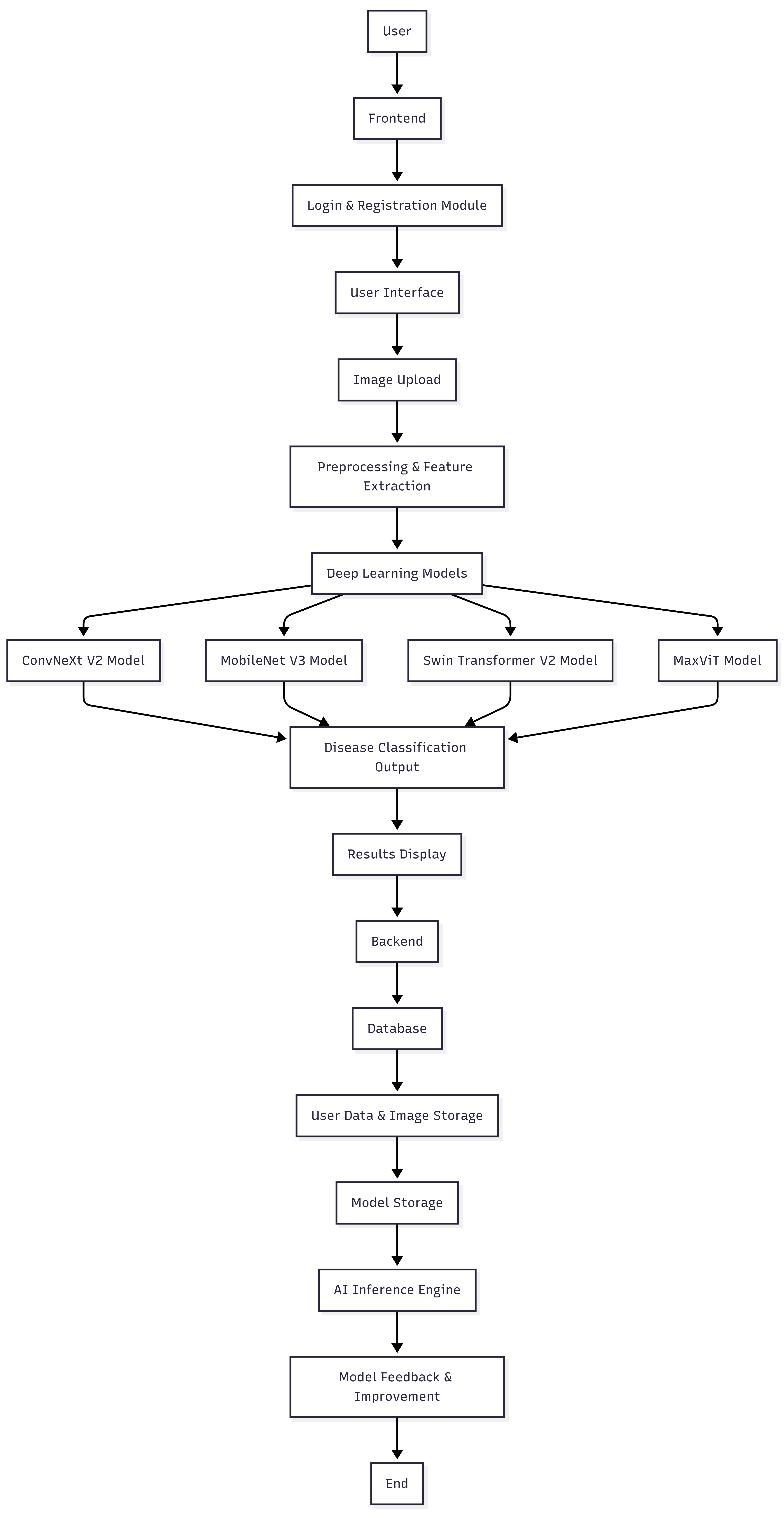
Block Diagram
Specifications
SOFTWARE REQUIREMENS
Operating System : Windows 7/8/10
Server side Script : HTML, CSS, Bootstrap & JS
Programming Language : Python
Libraries :Flask, Torch, Tensorflow, Pandas, Mysql.connector
IDE/Workbench : VSCode
Server Deployment : Xampp Server
Database : MySQL
HARDWARE REQUIREMENTS
Processor - I3/Intel Processor
RAM - 8GB (min)
Hard Disk - 128 GB
Key Board - Standard Windows Keyboard
Mouse - Two or Three Button Mouse
Monitor - Any


 Paper Publishing

Request Call Back
Would you like to receive a free callback now?
Choose the best time for callback:
Leave your message and we will contact you as soon as possible

6-2-85/B, Old Maternity Hospital Road, Thyagaraja Nagar, Tirupati, Andhra Pradesh – 517501
+91 9030333433
+91 9393939065
0877-2261612

Disclaimer - Takeoff Edu Group Projects are not associated or affiliated with IEEE in any way. The IEEE Projects mentioned here are mentioned in the context of student projects, whose ideas are derived from IEEE publications, not projects of or by IEEE.

