Transfer Learning for Misinformation Classification: A Deep Dive into Model Fine-Tuning and Adaptation Strategies
Objective
The goal of the project is to maximize the use of transfer learning approaches in the field of misinformation detection. Specifically, the deployment of sophisticated natural language processing models will be assessed and optimized for this purpose. Its specific goal is to determine the best methods for fine-tuning and adapting pre-trained models, including BERT and RoBERTa, so they may be used for the complex task of misinformation classification.
Abstract
The spread of false information presents a serious obstacle to accurate content categorization in the age of digital information overload. Using transfer learning techniques has become a viable way to tackle this problem by utilizing the knowledge of pre-trained models and modifying them for tasks related to misinformation categorization. In the framework of transfer learning for misinformation categorization, this paper undertakes a thorough investigation of several fine-tuning and adaptation methodologies. We explore the complexities of model selection, assessing the effectiveness of well-known architectures like BERT and RoBERTa in learning misleading patterns. We also examine various fine-tuning techniques, such as adapter-based, gradual unfreezing, and full fine-tuning, to determine how they affect model performance and generalization. Additionally, we look at adaptation techniques designed to lessen label shift and domain change. Noise, significant obstacles in actual deployment situations. We offer insights into the trade-offs between model complexity, adaption effort, and classification accuracy through extensive testing on benchmark datasets. Our results clarify transfer learning strategies that work well for misinformation classification and provide useful advice on how to use strong models to stop the spread of misinformation.
Keywords: Transfer learning, Misinformation classification, Model fine-tuning, Adaptation strategies
NOTE: Without the concern of our team, please don't submit to the college. This Abstract varies based on student requirements.
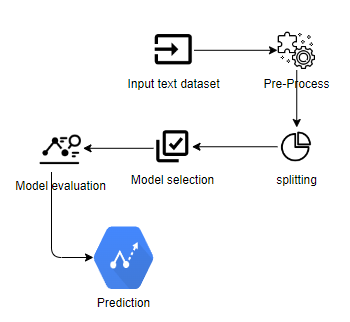
Block Diagram
Specifications
Hardware Requirements:
v Processor: Specifies the type and speed of the central processing unit (CPU) required to run the system efficiently.
v Memory (RAM): Specifies the minimum amount of random access memory (RAM) needed to support the system's operations and data processing.
v Storage: Specifies the amount of disk space required for installing the system and storing data, files, and other resources.
v Network Connectivity: Specifies the network interface and bandwidth requirements for connecting the system to local area networks (LANs), wide area networks (WANs), or the internet.
v Peripheral Devices: Specifies any additional hardware components or peripherals needed to interact with the system, such as printers, scanners, or specialized input devices.
Software Requirements:
v Operating System: Specifies the operating system (OS) required to run the system, including compatibility with specific OS versions and editions.
v Database Management System (DBMS): Specifies the database software required for storing, managing, and retrieving data, including compatibility with specific DBMS platforms and versions.
v Programming Languages/Frameworks: Specifies the programming languages, frameworks, and development tools needed for building and deploying the system's software components.
v Libraries and Dependencies: Specifies any third-party libraries, modules, or dependencies required for integrating additional functionality or features into the system.
v Configuration Settings: Specifies any specific software configurations or settings required for optimizing performance, security, or compatibility with other software components.

Demo Video


Request for Video
 Paper Publishing
Request Call Back
Would you like to receive a free callback now?
Choose the best time for callback:
Leave your message and we will contact you as soon as possible

6-2-85/B, Old Maternity Hospital Road, Thyagaraja Nagar, Tirupati, Andhra Pradesh – 517501
+91 9030333433
+91 9393939065
0877-2261612

Disclaimer - Takeoff Edu Group Projects are not associated or affiliated with IEEE in any way. The IEEE Projects mentioned here are mentioned in the context of student projects, whose ideas are derived from IEEE publications, not projects of or by IEEE.

