Towards Silicon Carbide Monolithic Active Pixel Radiation Sensors
Objective
These sensors are intended for applications in high-energy physics, space exploration, and medical imaging, where conventional silicon-based detectors may have limitations due to radiation damage and high-temperature conditions.
Abstract
Future collider experiments require tracking detectors with rapid data acquisition, high spatial and temporal resolution, and exceptional radiation hardness. Monolithic active pixel sensors (MAPS), based on silicon CMOS technology, have demonstrated excellent spatial and temporal resolution. However, for enhanced radiation hardness, wide bandgap semiconductors like silicon carbide (SiC) are promising candidates. This study marks the first step toward integrating MAPS with SiC-CMOS technology. We used the Fraunhofer IISB 2µm SiC-CMOS process to design the first stage of the MAPS electronic read-out chain: a charge-sensitive amplifier (CSA) circuit. Simulations indicate that an equivalent noise charge of 107e is achievable for a sensor capacitance of 1pF. The bandwidth reached 31kHz, which was constrained by the relatively large transistor sizes currently available in SiC-CMOS technology. Although SiC-CMOS is still in its early stages, we believe that with advancements in integration density, SiC-MAPS could become a viable and compelling alternative to silicon-based sensors.
NOTE: Without the concern of our team, please don't submit to the college. This Abstract varies based on student requirements.
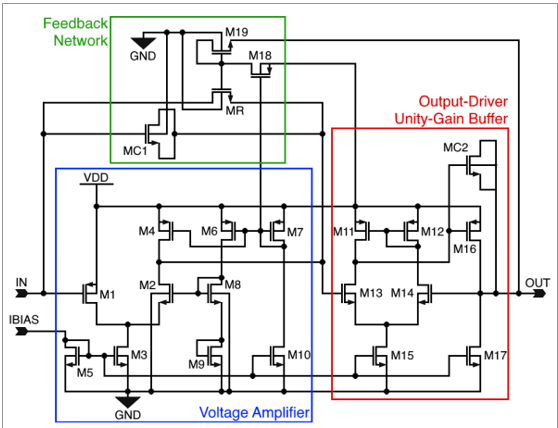
Block Diagram
Specifications
Software Requirements:
- Tool: Cadence Virtuoso
- Technology: GPDK 180 nm
Hardware Requirements:
- Microsoft® Windows XP
- Intel® Pentium® 4 processor or Pentium 4 equivalent with SSE support
- 512 MB RAM
- 100 MB of available disk space
Learning Outcomes
· Introduction to Analog & Digital Electronics
· Amplifier Topology:
· Charge sensitive amplifier:
· Neural Recording Applications:
· Circuit Analysis:
· Basics of operational amplifier:
· Operation of inverting amplifier:
· Biasing Techniques:
· Signal Integrity:


Related Projects
 Paper Publishing

Request Call Back
Would you like to receive a free callback now?
Choose the best time for callback:
Leave your message and we will contact you as soon as possible

6-2-85/B, Old Maternity Hospital Road, Thyagaraja Nagar, Tirupati, Andhra Pradesh – 517501
+91 9030333433
+91 9393939065
0877-2261612

Disclaimer - Takeoff Edu Group Projects are not associated or affiliated with IEEE in any way. The IEEE Projects mentioned here are mentioned in the context of student projects, whose ideas are derived from IEEE publications, not projects of or by IEEE.

