Towards Lightweight Provable Data Possession for Cloud Storage Using Indistinguishability Obfuscation
Objective
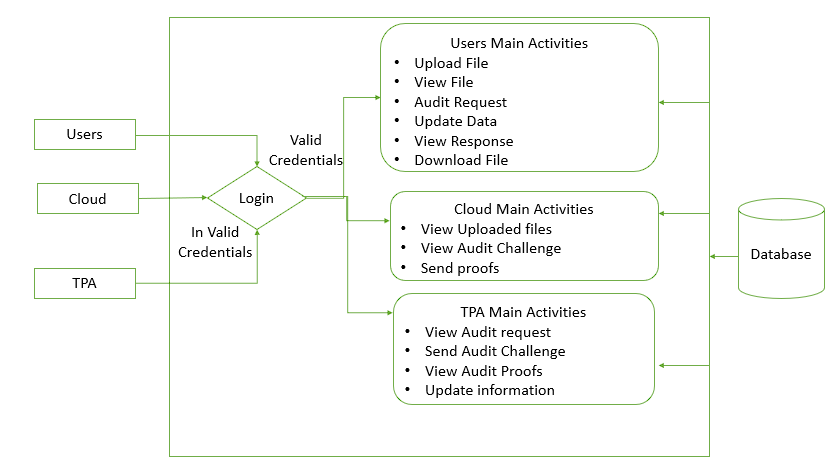
The objective of this study is to address the critical issue of key exposure in data integrity auditing for cloud storage by developing an innovative and efficient identity-based data integrity auditing scheme with key-exposure resilience. This is accomplished through the introduction of a novel key update technique compatible with BLS signatures, ensuring continuous functionality even if the user's private key is compromised. The Third Party Auditor (TPA) plays a pivotal role by generating update information, enabling users to update their private keys based on previous keys and the provided update information. The scheme supports a real lazy update approach, significantly enhancing the efficiency and feasibility of key updates. Additionally, the use of identity-based cryptography simplifies certificate management. Security proofs and performance analyses confirm that the proposed scheme offers robust security and operational efficiency.
Abstract
Cloud Computing has proved to be a boon for many individuals and organizations who cannot afford infrastructure and maintenance cost of resources. But the untrusted nature of Cloud Server (CS) brings many challenges related to security and trust. Public auditing is one process that enables users to delegate the integrity verification of outsourced data to external party such as Third-Party Audito r (TPA). Provable Data Possession (PDP) is one approach of auditing that can verify the integrity using cryptographic algorithms. Many PDP schemes are based on bilinear pairing and homomorphic authenticators that involves complex computations that leads to increased verification time. The lightweight auditing processes is a need today using modern cryptographic techniques. Indistinguishability Obfuscation (IO) is one of the modern but weaker primitive that, if used with one-way functions, provide multiple cryptographic constructs. Sahai and Waters proposed construction of cryptographic constructs using IO. Zhang et al. proposed lightweight public auditing scheme using these IO. But still there are many goals to achieve such as group support, collusion handling, privacy-preserving etc. using IO. In this paper, we are trying to explore these issues and lists future research directions in this field.
Keywords: Public auditing, provable data possession, homomorphic verifiable tags, indistinguishability obfuscation.
NOTE: Without the concern of our team, please don't submit to the college. This Abstract varies based on student requirements.
Block Diagram
Specifications
Hardware Requirements
Processor - I3/Intel Processor
Hard Disk - 160GB
Key Board - Standard Windows Keyboard
Mouse - Two or Three Button Mouse
Monitor - SVGA
RAM - 8GB
Software Requirements:
Operating System : Windows 7/8/10
Server side Script : HTML, CSS, Bootstrap & JS
Programming Language : Python
Libraries : Django
Technology : Python 3.6+
Database : SQLITE

Demo Video


Request for Video
 Paper Publishing
Request Call Back
Would you like to receive a free callback now?
Choose the best time for callback:
Leave your message and we will contact you as soon as possible

6-2-85/B, Old Maternity Hospital Road, Thyagaraja Nagar, Tirupati, Andhra Pradesh – 517501
+91 9030333433
+91 9393939065
0877-2261612

Disclaimer - Takeoff Edu Group Projects are not associated or affiliated with IEEE in any way. The IEEE Projects mentioned here are mentioned in the context of student projects, whose ideas are derived from IEEE publications, not projects of or by IEEE.

