Tongue Classification in TCM with Noisy Labels via Confident Learning
Objective
This study aims to enhance the accuracy and robustness of binary, tongue color classification in Traditional Chinese Medicine by addressing noisy label issues through Confident-Learning-Assisted Knowledge Distillation (CLAKD), leveraging deep learning techniques for improved diagnostic reliability.
Abstract
Traditional Chinese Medicine (TCM) encompasses a rich understanding of health and disease, often relying on visual cues such as tongue color to diagnose ailments. However, the subjective interpretation of tongue color poses challenges, especially when faced with noisy labels. In this study, we propose a novel approach for tongue color classification in TCM using deep learning techniques, specifically addressing the issue of noisy labels through Confident-Learning-Assisted Knowledge Distillation (CLAKD).The core of our methodology lies in the integration of confident learning and knowledge distillation techniques. Confident learning helps identify and mitigate the influence of noisy labels by iteratively re-weighting samples based on their estimated noise levels. Meanwhile, knowledge distillation enables the transfer of knowledge from a complex teacher model to a simpler student model, enhancing generalization and robustness.
To evaluate our approach, we curated a comprehensive dataset of tongue images annotated with color labels according to TCM principles. We introduced noise into the labels to simulate real-world scenarios where misinterpretations or variations in diagnosis occur. Our experiments demonstrate that CLAKD significantly improves classification accuracy compared to baseline methods, especially under noisy label conditions. Furthermore, our approach exhibits resilience to varying levels of label noise, showcasing its adaptability to different diagnostic contexts.In addition to performance evaluation, we provide insights into the learned representations by visualizing the decision boundaries and feature embeddings of the models. These analyses shed light on the discriminative features leveraged by the models for tongue color classification, offering valuable interpretability to practitioners.
Overall, our study presents a promising framework for automated tongue diagnosis in TCM, offering improved accuracy and robustness in the presence of noisy labels. By harnessing the power of deep learning and innovative techniques like CLAKD, we pave the way for more reliable and scalable diagnostic tools in traditional medical practices.
KEYWORD: Traditional Chinese Medicine (TCM), Tongue color classification, Confident learning, Knowledge distillation.
NOTE: Without the concern of our team, please don't submit to the college. This Abstract varies based on student requirements.
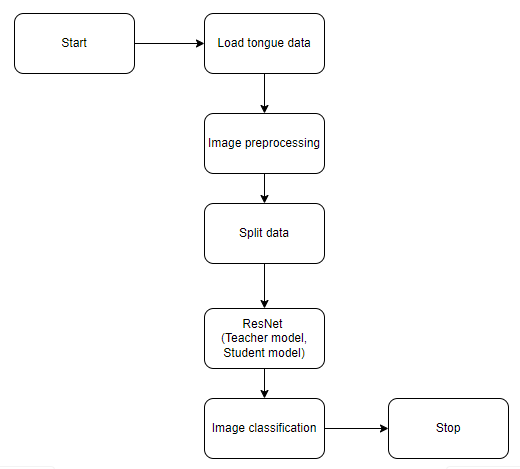
Block Diagram
Specifications
H/W SPECIFICATIONS:
• Processor : I5/Intel Processor
• RAM : 8GB (min)
• Hard Disk : 128 GB
• Key Board : Standard Windows Keyboard
• Mouse : Two or Three Button Mouse
• Monitor : Any
S/W SPECIFICATIONS:
• Operating System : Windows 7+
• Server-side Script : Python 3.6+
• IDE : PyCharm.
• Libraries Used : Pandas, Numpy, Matplotlib, OS.

Demo Video


Request for Video
 Paper Publishing
Request Call Back
Would you like to receive a free callback now?
Choose the best time for callback:
Leave your message and we will contact you as soon as possible

6-2-85/B, Old Maternity Hospital Road, Thyagaraja Nagar, Tirupati, Andhra Pradesh – 517501
+91 9030333433
+91 9393939065
0877-2261612

Disclaimer - Takeoff Edu Group Projects are not associated or affiliated with IEEE in any way. The IEEE Projects mentioned here are mentioned in the context of student projects, whose ideas are derived from IEEE publications, not projects of or by IEEE.

