Time Series Forecasting and Modelling of Food Demand Supply Chain Based on Regressors Analysis
Objective
The primary objective of this project is to develop a robust demand forecasting model for the food industry using machine learning and deep learning techniques. By comparing various regression algorithms, we aim to identify the most accurate model for predicting the number of orders. The project seeks to minimize the Root Mean Squared Log Error (RMSLE), Root Mean Square Error (RMSE), Mean Average Percentage Error (MAPE), and Mean Average Error (MAE) to enhance forecasting precision.
Abstract
Accurate demand forecasting has become extremely important, particularly in the food industry, because many products have a short shelf life, and improper inventory management can result in significant waste and loss for the company. Several machine learning and deep learning techniques recently showed substantial improvements when handling time-dependent data. This paper takes the ‘Food Demand Forecasting’ dataset released by Genpact, compares the effect of various factors on demand, extracts the characteristic features with possible influence, and proposes a comparative study of seven regressors to forecast the number of orders. In this study, we used Random Forest Regressor, Gradient Boosting Regressor (GBR), Light Gradient Boosting Machine Regressor (LightGBM), Extreme Gradient Boosting Regressor (XGBoost), Cat Boost Regressor, Long Short-Term Memory (LSTM), Bidirectional LSTM (BiLSTM) in particular. The results demonstrate the potential of deep learning models in forecasting and highlight the superiority of LSTM over other algorithms. The Root Mean Squared Log Error (RMSLE), Root Mean Square Error (RMSE), Mean Average Percentage Error (MAPE), and Mean Average Error (MAE) reach 0.28, 18.83, 6.56%, and 14.18, respectively.
Keywords: Random Forest Regressor, Gradient Boosting Regressor (GBR), Light Gradient Boosting Machine Regressor (LightGBM), Extreme Gradient Boosting Regressor (XGBoost), Cat Boost Regressor, Long Short-Term Memory (LSTM), Bidirectional LSTM (BiLSTM)
NOTE: Without the concern of our team, please don't submit to the college. This Abstract varies based on student requirements.
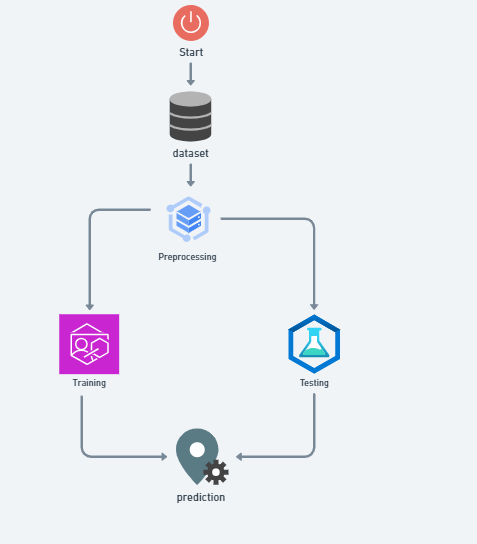
Block Diagram
Specifications
Hardware Requirements:
· Operating system : Windows 7 or 7+
· RAM : 8 GB
· Hard disc or SSD : More than 500 GB
· Processor : Intel 3rd generation or high or Ryzen with 8 GB Ram
Software Requirements:
· Software’s : Python 3.6 or high version
· IDE : PyCharm.
· Framework : Flask, pandas, NumPy and Scikit-Lear


 Paper Publishing

Request Call Back
Would you like to receive a free callback now?
Choose the best time for callback:
Leave your message and we will contact you as soon as possible

6-2-85/B, Old Maternity Hospital Road, Thyagaraja Nagar, Tirupati, Andhra Pradesh – 517501
+91 9030333433
+91 9393939065
0877-2261612

Disclaimer - Takeoff Edu Group Projects are not associated or affiliated with IEEE in any way. The IEEE Projects mentioned here are mentioned in the context of student projects, whose ideas are derived from IEEE publications, not projects of or by IEEE.

