The Intelligent Tutor
Objective
The Intelligent Tutor is an online course-selling platform designed for students and professionals. It provides a seamless experience for users to access and manage educational content
Abstract
The Intelligent Tutor is an innovative online course-selling platform tailored for students and professionals seeking to enhance their skills and knowledge in various domains. Designed to provide a seamless and intuitive user experience, The Intelligent Tutor offers a comprehensive educational ecosystem where learners can access, manage, and track their educational content efficiently. By integrating advanced learning management features, the platform allows users to explore a wide range of courses, from foundational to advanced topics, in a structured and engaging format.
The platform emphasizes personalized learning by offering curated course recommendations based on users' learning progress and interests. It supports multiple content types, including video lectures, reading materials, quizzes, and interactive exercises, ensuring a diverse and enriching educational experience. The Intelligent Tutor also incorporates performance analytics, enabling learners to assess their progress and identify areas for improvement. For instructors, it offers easy-to-use tools for content creation, course management, and learner engagement.
Ultimately, The Intelligent Tutor aims to bridge the gap between traditional education and the evolving needs of modern learners by providing accessible, high-quality learning opportunities. By fostering an environment conducive to both self-paced learning and instructor-led training, it empowers users to take control of their educational journeys, equipping them with the skills required for personal and professional growth.
Keywords: Intelligent Tutor, Online Course, Learning Management, Knowledge, Education Ecosystem and Course Management.
NOTE: Without the concern of our team, please don't submit to the college. This Abstract varies based on student requirements.
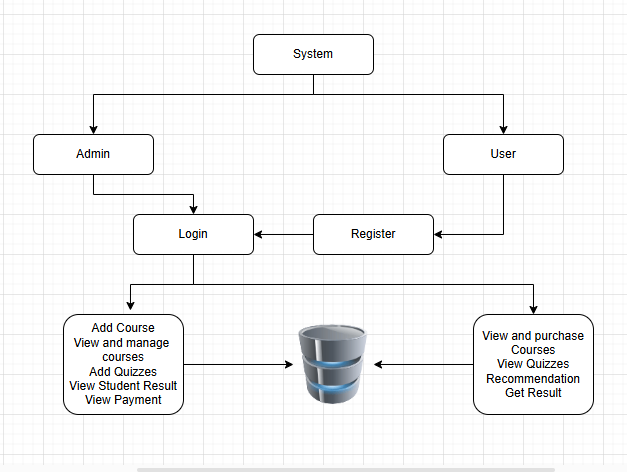
Block Diagram
Specifications
Hardware Specifications:
-
Server Configuration:
-
Processor: Quad-core processor or higher (Intel i5/i7 or equivalent)
-
RAM: 8GB or more
-
Storage: Minimum 500GB SSD for fast data access and storage
-
Graphics Card (Optional): Dedicated GPU (for advanced visualizations or AI/ML processing)
-
Network: High-speed internet connection (minimum 1 Gbps) for seamless operation and course delivery
-
-
User Devices:
-
Desktops/Laptops: Any modern PC or laptop running Windows, macOS, or Linux with at least 4GB RAM and 500GB storage
-
Mobile Devices: Smartphones and tablets running Android (5.0+) or iOS (10.0+) for access to courses on the go
-
-
Instructor Devices:
-
Desktops/Laptops: Higher performance machines with at least 8GB RAM and 500GB SSD for content creation and management
-
-
Backup Server:
- Backup server to ensure data redundancy and safety of course content, student data, and analytics
Software Specifications:
-
Backend Technologies:
-
Web Framework: Python with Flask or Django (for web application development)
-
Database: MySQL, PostgreSQL, or MongoDB for storing user, course, and transaction data
-
Authentication: JWT (JSON Web Tokens) or OAuth for secure login and authentication
-
Payment Gateway Integration: PayPal, Stripe, or Razorpay (for course purchases)
-
-
Frontend Technologies:
-
HTML5: For building structured and responsive web pages
-
CSS3: For styling and designing responsive user interfaces
-
JavaScript: For dynamic content and interactive features
-
Frontend Frameworks: ReactJS or Angular for single-page application (SPA) functionality and seamless user experience
-
-
Learning Management System (LMS):
-
Video Streaming: Integration with platforms like YouTube, Vimeo, or a self-hosted solution for video courses
-
Interactive Content: Support for quizzes, assignments, and interactive exercises using HTML5 or third-party LMS plugins
-
Analytics Tools: Google Analytics or custom performance tracking for assessing student progress
-
-
AI and Machine Learning:
-
Personalized Recommendations: Python libraries such as Scikit-learn, TensorFlow, or PyTorch for personalized course recommendations and adaptive learning
-
Data Analytics: Python with Pandas, Numpy, Matplotlib, and Seaborn for tracking learner performance and analytics
-
Recommendation Engine: Collaborative filtering or content-based filtering for course recommendations
-
-
Security:
-
Encryption: SSL/TLS for secure data transmission and AES encryption for sensitive data storage
-
Firewalls: For preventing unauthorized access to the backend and database
-
Anti-Malware Protection: To safeguard the platform against malware and external threats
-
-
Cloud and Hosting:
-
Cloud Hosting Provider: AWS (Amazon Web Services), Google Cloud, or Microsoft Azure for hosting the application and databases, ensuring scalability and reliability
-
Load Balancer: To distribute traffic evenly across multiple servers, ensuring high availability and fast response times
-
CDN (Content Delivery Network): To serve static content like videos, images, and assets faster across the globe
-
-
- Backup server to ensure data redundancy and safety of course content, student data, and analytics


 Paper Publishing

Request Call Back
Would you like to receive a free callback now?
Choose the best time for callback:
Leave your message and we will contact you as soon as possible

6-2-85/B, Old Maternity Hospital Road, Thyagaraja Nagar, Tirupati, Andhra Pradesh – 517501
+91 9030333433
+91 9393939065
0877-2261612

Disclaimer - Takeoff Edu Group Projects are not associated or affiliated with IEEE in any way. The IEEE Projects mentioned here are mentioned in the context of student projects, whose ideas are derived from IEEE publications, not projects of or by IEEE.

