The Health Benefits of Improved Air Quality Through a Mini Ozone Generator in Train Compartments
Objective
To enhance air quality in train compartments by using a system of gas sensors and a mini ozone generator, aiming to reduce harmful pollutants and improve passenger health and comfort during travel.
Abstract
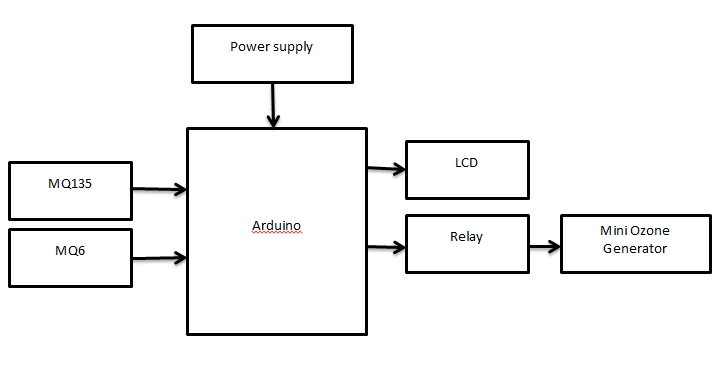
In this project, we focus on enhancing air quality within train compartments through an integrated system comprising gas sensors, an Arduino controller, and a mini ozone generator. Trains, often characterized by confined spaces and high passenger density, can experience significant air quality issues due to elevated levels of CO2 and various harmful gases. To address these concerns, our system utilizes the MQ135 sensor to detect CO2 levels and the MQ6 sensor to monitor the presence of other gases such as methane and LPG. Data from these sensors are processed by an Arduino microcontroller and displayed in real-time on an LCD screen for easy monitoring by train staff.When the sensors detect CO2 or gas levels exceeding predefined thresholds, the Arduino triggers a relay to activate the mini ozone generator. Ozone, known for its powerful oxidizing properties, is used to neutralize pollutants and improve overall air quality. By employing this proactive approach, the system aims to create a healthier and more comfortable environment for passengers. The use of the mini ozone generator, managed by the Arduino, ensures that the air remains fresh, reducing the risks associated with poor air quality, such as respiratory issues and discomfort, thereby enhancing passenger well-being during their journey.
Keywords: MQ135 sensor, MQ6 sensor, Arduino.
NOTE: Without the concern of our team, please don't submit to the college. This Abstract varies based on student requirements.
Block Diagram
Specifications
Hardware Requirements:
- Arduino
- MQ135
- MQ6
- LCD
- RELAY
- Mini Ozone Generator
- Power supply
Software Requirements:
- Arduino IDE
- Embedded C
Learning Outcomes
Learning outcomes:
- Arduino Pin diagram and Architecture
- Installation for Arduino IDE
- Basic coding in Embedded C
- Working of MQ135 sensor
- How to connect MQ135 sensor to Arduino?
- Working of MQ6
- How to connect MQ6 to Arduino?
- Working of LCD
- Working of Relay ?
- How to connect LCD to Arduino?
- About Project Development Life Cycle:
- Planning and Requirement Gathering (software’s, Tools, Hardware components, etc.,)
- Schematic preparation
- Code development and debugging
- Hardware development and debugging
- Development of the Project and Output testing
- Practical exposure to:
- Hardware and software tools.
- Solution providing for real time problems.
- Working with team/ individual.
- Work on Creative ideas.
- Project development Skills
- Problem analyzing skills
- Problem solving skills
- Creativity and imaginary skills
- Programming skills
- Deployment
- Testing skills
- Debugging skills
- Project presentation skills
- Thesis writing skills


 Paper Publishing

Request Call Back
Would you like to receive a free callback now?
Choose the best time for callback:
Leave your message and we will contact you as soon as possible

6-2-85/B, Old Maternity Hospital Road, Thyagaraja Nagar, Tirupati, Andhra Pradesh – 517501
+91 9030333433
+91 9393939065
0877-2261612

Disclaimer - Takeoff Edu Group Projects are not associated or affiliated with IEEE in any way. The IEEE Projects mentioned here are mentioned in the context of student projects, whose ideas are derived from IEEE publications, not projects of or by IEEE.

