The graphical isomorphism network algorithm for pcod for disease prediction and risk stratification
Objective
This project leverages Graphical Isomorphism Networks (GIN) to model complex relationships among clinical, hormonal, and lifestyle factors for accurate PCOD disease prediction and risk stratification. The system enables early diagnosis, personalized risk assessment, and data-driven healthcare decisions, improving clinical efficiency and patient outcomes through advanced graph-based machine learning techniques.
Abstract
The Graphical Isomorphism Network (GIN) algorithm is employed for disease prediction and risk stratification of Polycystic Ovary Disease (PCOD/PCOS), which is an intricate condition impacting numerous women worldwide. The research leverages the power of graph-based algorithms, specifically GIN, to better understand complex relationships between various health parameters and predict the likelihood of PCOD. The dataset consists of vital health features such as age, height, weight, menstrual cycle data, and more, which are analyzed using state-of-the-art machine learning techniques.
In the project, multiple machine learning models are evaluated, including Random Forest (RF), XGBoost, and Convolutional Neural Networks (CNN), to ascertain their efficacy in PCOD diagnosis and stratification. Among them, Random Forest has shown remarkable performance, achieving an accuracy of 93.43%, making it the most reliable model for the task at hand. XGBoost also performs well with an accuracy of 93.50%. Meanwhile, CNN showed promising results with an accuracy of 84.90%.
The overall framework integrates Flask, a lightweight Python web framework, with a MySQL database for managing user registrations and model predictions, offering a seamless user experience. The system allows users to upload datasets, select different models, and receive health predictions with actionable recommendations based on the output. This approach enables personalized health management, ensuring women are more informed about their risk factors for PCOD and can make better decisions regarding their health.
Keywords:
Graphical Isomorphism Network (GIN), PCOD, Disease Prediction, Risk Stratification, Random Forest (RF), Health State Prediction, Machine Learning, Feature Engineering, Medical Data Analysis, Personalized Health Recommendations, Flask Web Application, Model Performance, Health Technology
NOTE: Without the concern of our team, please don't submit to the college. This Abstract varies based on student requirements.
Block Diagram
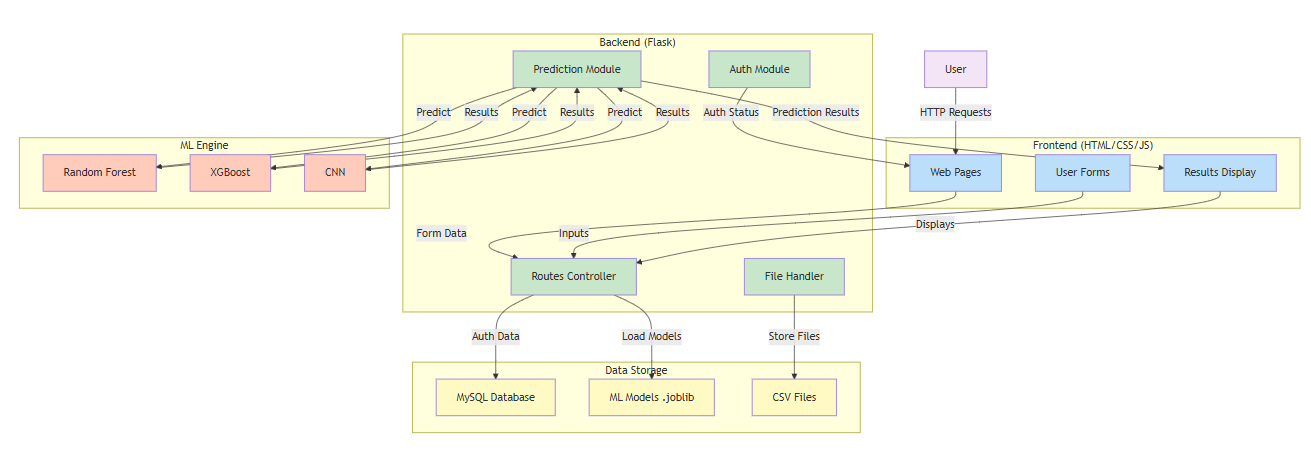
Specifications
SOFTWARE REQUIREMENS
Operating System : Windows 7/8/10
Server side Script : HTML, CSS, Bootstrap & JS
Programming Language : Python
Libraries : Flask, Pandas, Torch, Keras, Sklearn, Numpy , Seaborn
IDE/Workbench : VSCode
Server Deployment : Xampp Server
Database : MySQL
HARDWARE REQUIREMENTS
Processor - I3/Intel Processor
RAM - 8GB (min)
Hard Disk - 128 GB
Key Board - Standard Windows Keyboard
Mouse - Two or Three Button Mouse
Monitor - Any


 Paper Publishing

Request Call Back
Would you like to receive a free callback now?
Choose the best time for callback:
Leave your message and we will contact you as soon as possible

6-2-85/B, Old Maternity Hospital Road, Thyagaraja Nagar, Tirupati, Andhra Pradesh – 517501
+91 9030333433
+91 9393939065
0877-2261612

Disclaimer - Takeoff Edu Group Projects are not associated or affiliated with IEEE in any way. The IEEE Projects mentioned here are mentioned in the context of student projects, whose ideas are derived from IEEE publications, not projects of or by IEEE.

