The Effect of Input Length on Prediction Accuracy in Short-Term Multi-Step Electricity Load Forecasting: A CNN-LSTM Approach
Objective
This project focuses on short-term electricity load forecasting using deep learning models, including GRU, CNN-LSTM, BiLSTM, and a CNN-RNN hybrid.
Abstract
This project investigates the effect of input sequence length on the accuracy of short-term multi-step electricity load forecasting using deep learning techniques. Using a real-world dataset from Panama's electricity consumption records, we implemented and compared the performance of four models: GRU, CNN-LSTM, Bidirectional LSTM (BiLSTM) with Dense layers, and a CNN-RNN hybrid. The models were evaluated for both hourly and daily forecasting to determine the optimal input configuration and architecture for high-precision predictions. Among these, the CNN-LSTM model demonstrated superior performance and was selected for deployment. To enable practical usage, we developed a Flask-based web application with an intuitive front end using HTML, CSS, and JavaScript. After user login, the application allows users to input specific dates and receive accurate load forecasts along with interactive graphs. This system provides a reliable and user-friendly platform for electricity demand forecasting, supporting better planning and decision-making in energy management.
Keywords:
Short-term load forecasting, CNN-LSTM, GRU, BiLSTM, CNN+RNN, electricity
demand, input length, deep learning, Flask web app, time series prediction,
energy forecasting.
NOTE: Without the concern of our team, please don't submit to the college. This Abstract varies based on student requirements.
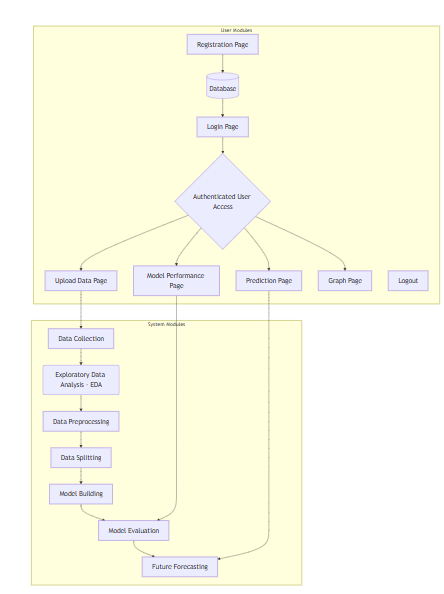
Block Diagram
Specifications
SOFTWARE REQUIREMENS
Operating System : Windows 7/8/10
Server-side Script : HTML, CSS, Bootstrap & JS
Programming Language : Python
Libraries : Flask, Pandas,, Sklearn,NumPy, Seaborn, Matplotlib,Tensorflow
IDE/Workbench : VSCode
Technology : Python 3.8+
Server Deployment : Xampp Server
Database : MySQL
HARDWARE REQUIREMENTS
Processor - I5/Intel Processor
RAM - 8GB+ (min)
Hard Disk - 128 GB+
Key Board - Standard Windows Keyboard
Mouse - Two or Three Button Mouse
Monitor - Any


 Paper Publishing

Request Call Back
Would you like to receive a free callback now?
Choose the best time for callback:
Leave your message and we will contact you as soon as possible

6-2-85/B, Old Maternity Hospital Road, Thyagaraja Nagar, Tirupati, Andhra Pradesh – 517501
+91 9030333433
+91 9393939065
0877-2261612

Disclaimer - Takeoff Edu Group Projects are not associated or affiliated with IEEE in any way. The IEEE Projects mentioned here are mentioned in the context of student projects, whose ideas are derived from IEEE publications, not projects of or by IEEE.

