The Early Detection of Dementia Disease Using Machine Learning Approach
Objective
The main objective of "The Early Detection of Dementia Disease Using Machine Learning Approach" is to develop a predictive model that can accurately determine whether a person is demented or not based on relevant data and features. By utilizing machine learning techniques, the aim is to identify potential signs of dementia at an early stage, enabling timely interventions and improving the overall prognosis for affected individuals.
Abstract
To recognize the basis of disease, it is essential to determine its underlying genes. Understanding the association between underlying genes and genetic disease is a fundamental problem regarding human health. Identification and association of genes with the disease require time consuming and expensive experimentations of a great number of potential candidate genes. Therefore, the alternative inexpensive and rapid computational methods have been proposed that can identify the candidate gene associated with a disease. Most of these methods use phenotypic similarities due to the fact that genes causing same or similar diseases have less variation in their sequence or network properties of protein-protein interactions based on-premises that genes lie closer in protein interaction network that causes the similar or same disease. However, these methods use only basic network properties or topological features and gene sequence information or biological features as a prior knowledge for identification of gene-disease association, which restricts the identification process to a single gene-disease association. In this study, we propose and analyze some novel computational methods for the identification of genes associated with diseases. Some advance topological and biological features that are overlooked currently are introducing for identifying candidate genes. We evaluate different computational methods on disease-gene association data from DisGeNET based on TP rate, FP rate, precision, recall, F-measure, and ROC curve evaluation parameters. The results reveal that various computational methods with advanced feature set outperform previous state-of-the-art techniques by achieving precision up to 93.8%, recall up to 93.1%, and F- measure up to 92.9%. Significantly, we apply our methods to study three major disease types: Group, Disease and Phenotype. Simulation results sho44w that the proposed Extreme Gradient Boosting Algorithm (XGBoost) gives more accurate results as compared to previously published approaches.
KEYWORDS: Machine Learning, XGBoost Classifier, Disease Gene Association, Random Forest, Decision Tree, AdaBoost, SVC, Logistic Regression CNN and MLP.
NOTE: Without the concern of our team, please don't submit to the college. This Abstract varies based on student requirements.
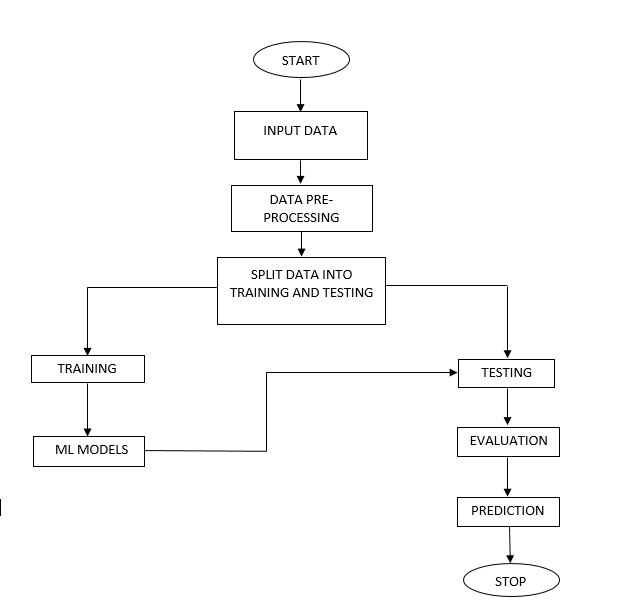
Block Diagram
Specifications
SOFTWARE REQUIREMENS
Operating System : Windows 7/8/10
Server side Script : HTML, CSS, Bootstrap & JS
Programming Language : Python
Libraries : Flask, Pandas, Mysql.connector, Os, Smtplib, Numpy
IDE/Workbench : PyCharm
Technology : Python 3.6+
Server Deployment : Xampp Server
Database : MySQL
HARDWARE REQUIREMENTS
Processor - I3/Intel Processor
Hard Disk - 160GB
Key Board - Standard Windows Keyboard
Mouse - Two or Three Button Mouse
Monitor - SVGA
RAM - 8GB


 Paper Publishing

Request Call Back
Would you like to receive a free callback now?
Choose the best time for callback:
Leave your message and we will contact you as soon as possible

6-2-85/B, Old Maternity Hospital Road, Thyagaraja Nagar, Tirupati, Andhra Pradesh – 517501
+91 9030333433
+91 9393939065
0877-2261612

Disclaimer - Takeoff Edu Group Projects are not associated or affiliated with IEEE in any way. The IEEE Projects mentioned here are mentioned in the context of student projects, whose ideas are derived from IEEE publications, not projects of or by IEEE.

