Text To Speech Concersion
Objective
The primary objective of this project is to create a user-friendly web-based platform that allows users to convert written text into speech effortlessly. By leveraging Python libraries for text-to-speech conversion, the project aims to provide a lightweight solution that requires no model training. This application aims to support individuals with visual impairments by providing them with an easy method to access written content audibly.
Abstract
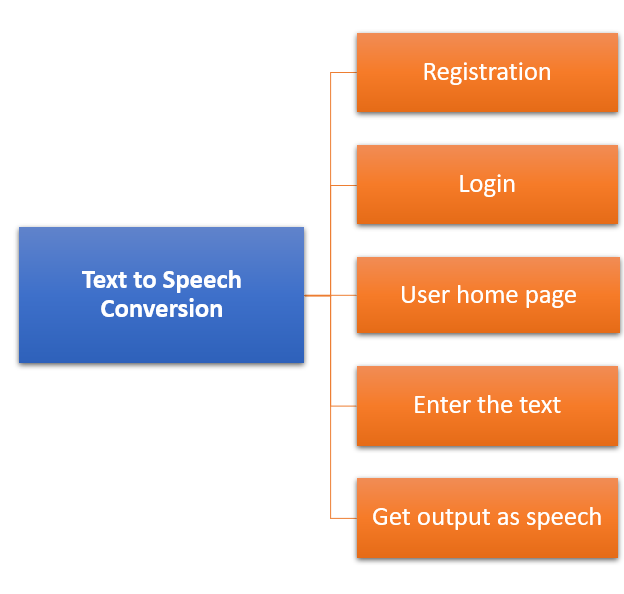
Text-to-Speech (TTS) conversion is an essential technology that enables computers to read aloud written text, providing accessibility for visually impaired users and enhancing user experience across various applications. This project focuses on developing a web-based application that converts user-provided text into speech. The system comprises a front-end interface built using HTML, CSS, and JavaScript, while the back-end is powered by Python. The application follows a simple flow: users register, log in, input text, receive audio output, and log out. The core functionality relies on a Python library for text-to-speech conversion, eliminating the need for model training. The application aims to provide an intuitive and accessible method of converting written content into clear and natural speech.
Keywords: Text-to-speech, accessibility, Python, web application, HTML, CSS, JavaScript, conversion, audio output, user interface.
NOTE: Without the concern of our team, please don't submit to the college. This Abstract varies based on student requirements.
Block Diagram
Specifications
Hardware Requirements
Processor - I3/Intel Processor
Hard Disk - 160GB
Key Board - Standard Windows Keyboard
Mouse - Two or Three Button Mouse
Monitor - SVGA
RAM - 8GB
Software Requirements
• Operating System : Windows 7/8/10
• Programming Language : Python
• Libraries : GTTS (Google Text-to-Speech) or pyttsx3
• IDE/Workbench : Visual Studio Code.


 Paper Publishing

Request Call Back
Would you like to receive a free callback now?
Choose the best time for callback:
Leave your message and we will contact you as soon as possible

6-2-85/B, Old Maternity Hospital Road, Thyagaraja Nagar, Tirupati, Andhra Pradesh – 517501
+91 9030333433
+91 9393939065
0877-2261612

Disclaimer - Takeoff Edu Group Projects are not associated or affiliated with IEEE in any way. The IEEE Projects mentioned here are mentioned in the context of student projects, whose ideas are derived from IEEE publications, not projects of or by IEEE.

