Test Versus Security Past and Present
Also Available Domains Testing|Xilinx Vivado
Abstract
Abstract:
Cryptographic circuits need to be protected against side-channel attacks, which target their physical attributes while the cryptographic algorithm is in execution. There can be various side-channels, such as power, timing, electromagnetic radiation, fault response, and so on. One such important side-channel is the design-for-testability (DfT) infrastructure present for effective and timely testing of VLSI circuits. The attacker can extract secret information stored on the chip by scanning out test responses against some chosen plaintext inputs. The purpose of this paper is to first present a detailed survey on the state-of-the-art in scan-based side-channel attacks on symmetric and public-key cryptographic hardware implementations, both in the absence and presence of advanced DfT structures, such as test compression and X-masking, which may make the attack difficult. Then, the existing scan attack countermeasures are evaluated for determining their security against known scan attacks. In addition, JTAG vulnerability and security countermeasures are also analysed as part of the external test interface. A comparative area-timing-security analysis of existing countermeasures at various abstraction levels is presented in order to help an embedded security designer make an informed choice for his intended application.
NOTE: Without the concern of our team, please don't submit to the college. This Abstract varies based on student requirements.
Block Diagram
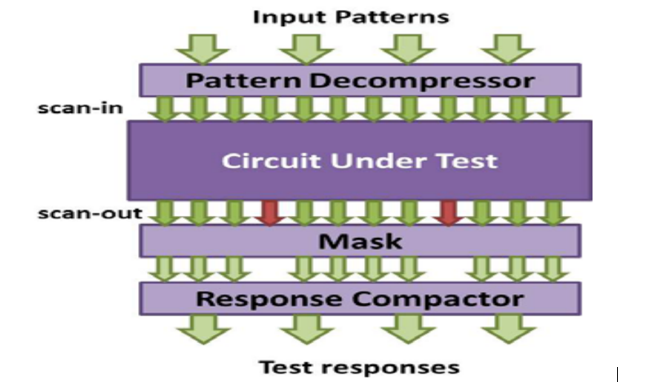
Specifications
Hardware requirement
Processor - Pentium –III
Speed - 1.1 GHz
RAM - 1 GB (min)
Hard Disk - 40 GB
Floppy Drive - 1.44 MB
Key Board - Standard Windows Keyboard
Mouse - Two or Three Button Mouse
Monitor - SVGA
Software requirements
v Operating System :Windows95/98/2000/XP/Windows7
v Front End : Modelsim 6.3 for Debugging and Xilinx 14.3 for Synthesis and Hard Ware Implementation
Learning Outcomes
Learning Outcomes:
- Introduction to Digital Electronics
- Analysis of digital circuits
- Importance of Multipliers
- Disadvantages of existing multipliers
- Knowledge on bypass technique
- Xilinx ISE/VIVADO software tool for code and simulation
- Solution providing for real time problems
- Project Development Skills:
- Problem Analysis Skills
- Problem Solving Skills
- Logical Skills


 Paper Publishing

Request Call Back
Would you like to receive a free callback now?
Choose the best time for callback:
Leave your message and we will contact you as soon as possible

6-2-85/B, Old Maternity Hospital Road, Thyagaraja Nagar, Tirupati, Andhra Pradesh – 517501
+91 9030333433
+91 9393939065
0877-2261612

Disclaimer - Takeoff Edu Group Projects are not associated or affiliated with IEEE in any way. The IEEE Projects mentioned here are mentioned in the context of student projects, whose ideas are derived from IEEE publications, not projects of or by IEEE.

