Ternary Toward Binary: Circuit-Level Implementation of Ternary Logic Using Depletion-Mode and Conventional MOSFETs
Objective
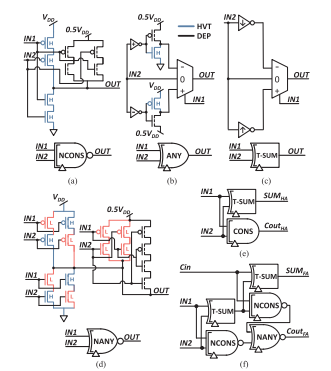
The objective is to design and implement ternary logic circuits at the transistor level using a combination of depletion-mode and conventional enhancement-mode MOSFETs. This project aims to explore multi-valued logic (MVL) as an alternative to binary logic, focusing on reducing circuit complexity, interconnect overhead, and power consumption. By bridging ternary logic with binary-compatible interfaces, the study evaluates the feasibility, performance, and efficiency of implementing compact, low-power logic circuits suitable for future digital and nanoelectronics systems.
Abstract
NOTE: Without the concern of our team, please don't submit to the college. This Abstract varies based on student requirements.
Block Diagram
Specifications
Software Requirements:
· Tool: H-Spice
Hardware Requirements:
· Microsoft® Windows XP
· Intel® Pentium® 4 processor or Pentium 4 equivalent with SSE support
· 512 MB RAM
· 100 MB of available disk space
Learning Outcomes
Learning Outcomes:
- Introduction to Digital electronics
- Introduction to logic gates
- Importance of Transistors
- Types of adders
- NMOS/PMOS/CMOS Technologies
- How to
design circuits using Transistor logic?
Comprehend DEPFET (depletion-mode MOSFET) and multi-threshold CMOS integration for ternary logic
-
How DEPFET devices (which turn ON even at zero gate bias) can help realize the “middle” logic state (0.5 VDD) in a ternary inverter or logic gate.
-
How combining DEPFET with multi-threshold (LVT/HVT) CMOS devices enables a complementary ternary logic scheme with lower static power and faster switching.
-


 Paper Publishing

Request Call Back
Would you like to receive a free callback now?
Choose the best time for callback:
Leave your message and we will contact you as soon as possible

6-2-85/B, Old Maternity Hospital Road, Thyagaraja Nagar, Tirupati, Andhra Pradesh – 517501
+91 9030333433
+91 9393939065
0877-2261612

Disclaimer - Takeoff Edu Group Projects are not associated or affiliated with IEEE in any way. The IEEE Projects mentioned here are mentioned in the context of student projects, whose ideas are derived from IEEE publications, not projects of or by IEEE.

