SYRG-PV-BES Based Standalone Microgrid Using Approximate Multipliers Based Adaptive Control
Objective
Main objective of this project is to improve convergence, better filtration capability with a reduced steady-state error. It will provide voltage regulation, harmonics mitigation, and load balancing while feeding nonlinear loads. The quality of power at PCC is improved.
Abstract
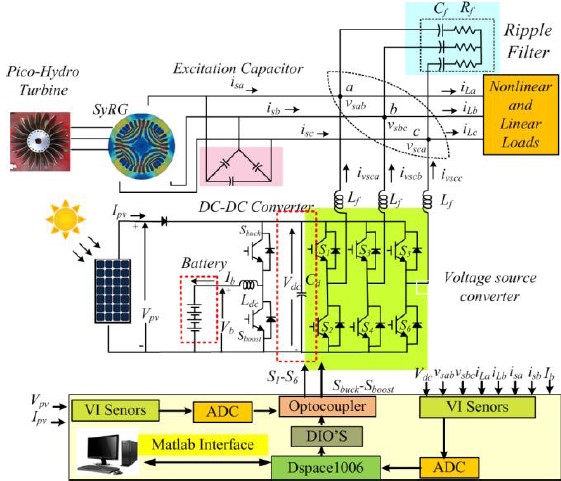
In this project, the adaptive control algorithm is used to maximize the Distributed Generations (DGs) in islanded micro-grid. The Approximate Multiplier Least Mean Square (AMLMS) control scheme is used for the extraction of fundamental load component with reduced steady state error and faster convergence to provide better performance than conventional LMS control. This control focuses on reduction of complexity of LMS by adding multipliers in the Finite Impulse Response (FIR) filter and updating the coefficients.
The AMLMS control algorithm for a Voltage Source Converter (VSC) is also effective in compensating harmonics for Power Quality (PQ) improvement of islanded micro-grid system while feeding nonlinear load. In an islanded micro-grid at AC side, a Synchronous Reluctance Generator (SyRG) based pico-hydropower generator is used because it is economical than other conventional generators. At DC side, a Photo Voltaic (PV) array and a Bidirectional DC-DC Converter (BDC) are used.
The BDC with a storage battery, maintains the optimal power flow to provide the power equilibrium between load and sources through DC link voltage regulation. The BDC also mitigates the second order harmonic from the battery charging and discharging current. Test and simulation results validate the effectiveness of AMLMS control under steady and dynamic conditions of solar insolation change and load unbalance.
Keywords: Distributed Generation, Micro-grids, Approximate Multiplier Least Mean Square, Finite Impulse Response, Voltage Source Converter and Synchronous Reluctance Generator.
NOTE: Without the concern of our team, please don't submit to the college. This Abstract varies based on student requirements.
Block Diagram
Specifications
Software Configuration:
Operating System : Windows 7/8/10
Application Software : Matlab/Simulink
Hardware Configuration:
RAM : 8 GB / 4 GB (Min)
Processor : I3 / I5(Mostly prefer)
Learning Outcomes
- Introduction to Matlab/Simulink
- What is EISPACK & LINPACK
- How to start with MATLAB
- About Matlab language
- About tools & libraries
- Application of Matlab/Simulink
- About Matlab desktop
- Features of Matlab/Simulink
- Basics on Matlab/Simulink
- Introduction to Power Distribution Systems
- Introduction to Renewable Energy Sources
- Introduction to Solar Power System
- Introduction to MPPT.
- Introduction to synchronous reluctance generator (SyRG)
- Introduction to Pico-hydropower generator
- Introduction to power electronic devices
- Introduction to Types of Batteries.
- Introduction to Lithium Battery.
- Introduction to approximate multiplier least mean square (AMLMS) control
- Introduction to Pulse Width Modulation (PWM),
- Design of Solar Panel.
- How to implement boost converter control?
- We can learn about the Standalone Micro-Grids
- Introduction to open loop and closed loop control system
- Introduction to bidirectional DC-DC converter (BDC).
- Introduction to Voltage Source Converters (VSC)
- We can learn about PI Controllers
- We can learn about different types of loads.
- We can learn about Mathematical model of Solar panel
- Project Development Skills:
- Problem analyzing skills
- Problem solving skills
- Creativity and imaginary skills
- Programming skills
- Deployment
- Testing skills
- Debugging skills
- Project presentation skills
- Thesis writing skills


 Paper Publishing

Request Call Back
Would you like to receive a free callback now?
Choose the best time for callback:
Leave your message and we will contact you as soon as possible

6-2-85/B, Old Maternity Hospital Road, Thyagaraja Nagar, Tirupati, Andhra Pradesh – 517501
+91 9030333433
+91 9393939065
0877-2261612

Disclaimer - Takeoff Edu Group Projects are not associated or affiliated with IEEE in any way. The IEEE Projects mentioned here are mentioned in the context of student projects, whose ideas are derived from IEEE publications, not projects of or by IEEE.

