SWEEPER: Secure Waterfall Energy-Efficient Protocol-Enabled Routing in FANET
Objective
To develop a secure and energy-efficient routing protocol for FANETs using the SWEEPER framework, focusing on trust-based node selection, cryptographic key management, and reducing packet loss for improved performance.
Abstract
Ad-hoc network developments in recent times have given rise to novelties such as FANETs. Applications for FANETs (Flying Ad hoc Networks) have expanded to include emergency services, military use, and agriculture, among other areas. UAVs populate the FANET environment, which must be dynamic. Transmitting data between nodes is the responsibility of the extremely mobile UAVs. If ignored, this leads to loss of packets. FANETs can provide reliable data transfer if they have efficient routing procedures in place location. A Secure Waterfall Energy-Efficient Protocol-Enabled Routing (SWEEPER) has been used in this study been suggested that aids in node energy conservation during the transmission process. The framework employs a waterfall model approach, with group key management serving as the foundational procedure in charge of the protocol's security. The use of asymmetric key cryptography. Our approach comprises two distinct nodes: the Computed Key (CKey) and the Dissemination Key (DKey). The two nodes will create, validate, and distribute the secret keys. This will allow other nodes to focus solely on transmission without wasting time on computational activities or key handling. Security breaches and cancerous nodes are also treated effectively. The nodes along the route are chosen based on a trust factor, which enables our protocol to select only authentic nodes will forward packets along the discovered path. Our work is analyzed using known techniques. FANETS include SecRIP and MDRMA. Our protocol beats existing protocols in terms of minimal delay, energy conservation, and PDR. This helps to a maximum throughput.
NOTE: Without the concern of our team, please don't submit to the college. This Abstract varies based on student requirements.
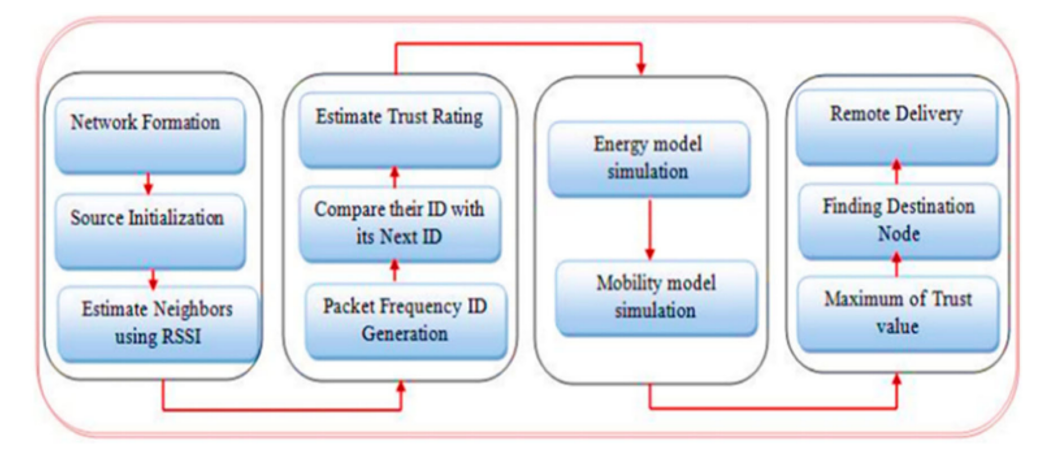
Block Diagram
Specifications
Software: Matlab 2020a or above
Hardware:
Operating Systems:
- Windows 10
- Windows 7 Service Pack 1
- Windows Server 2019
- Windows Server 2016
Processors:
Minimum: Any Intel or AMD x86-64 processor
Recommended: Any Intel or AMD x86-64 processor with four logical cores and AVX2 instruction set support
Disk:
Minimum: 2.9 GB of HDD space for MATLAB only, 5-8 GB for a typical installation
Recommended: An SSD is recommended A full installation of all MathWorks products may take up to 29 GB of disk space
RAM:
Minimum: 4 GB
Recommended: 8 GB
Learning Outcomes
· Introduction to Matlab
· What is EISPACK & LINPACK
· How to start with MATLAB
· About Matlab language
· Matlab coding skills
· About tools & libraries
· Application Program Interface in Matlab
· About Matlab desktop
· How to use Matlab editor to create M-Files
· Features of Matlab
· Basics on Matlab
· What is Communication?
· About Communication
· Introduction to Communication
· How Communication Works?
· Importing the System Design, Characterization and Visualization
· Analyzing of BER tool
· Analyzing of Error Rate Test Console
· Generation of WSN
· WSN network creation
· Nodes Communication
· Clustering
· Routing
· Convolutional
· Equalization and Synchronization etc.,
· How to extend our work to another real time applications
· Project development Skills
o Problem analyzing skills
o Problem solving skills
o Creativity and imaginary skills
o Programming skills
o Deployment
o Testing skills
o Debugging skills
o Project presentation skills
o Thesis writing skills
Demo Video


Request for Video
 Paper Publishing
Request Call Back
Would you like to receive a free callback now?
Choose the best time for callback:
Leave your message and we will contact you as soon as possible

6-2-85/B, Old Maternity Hospital Road, Thyagaraja Nagar, Tirupati, Andhra Pradesh – 517501
+91 9030333433
+91 9393939065
0877-2261612

Disclaimer - Takeoff Edu Group Projects are not associated or affiliated with IEEE in any way. The IEEE Projects mentioned here are mentioned in the context of student projects, whose ideas are derived from IEEE publications, not projects of or by IEEE.

