Student’s Engagement Detection Based on Computer Vision A Systematic Literature Review
Objective
The project titled "Student’s Engagement Detection Based on Computer Vision" leverages machine learning and computer vision techniques to analyze student engagement during online classes or in classrooms. The system utilizes EfficientNetB0, a deep learning model, to predict student engagement levels (confused, engaged, frustrated, looking away, or bored) from uploaded images. The web-based platform built using Flask allows users to register, log in, and upload images of students. The model processes the images and provides real-time predictions of the student's engagement, helping educators assess student attention and adjust teaching strategies.
Abstract
Student engagement plays an essential role in shaping academic achievement, learning efficiency, and meaningful classroom interaction. As digital and hybrid learning environments continue to grow, conventional observation-based engagement assessment becomes insufficient, creating a strong need for automated and objective monitoring systems. This systematic literature review provides a comprehensive evaluation of computer vision–driven techniques for identifying and interpreting students’ engagement levels through visual cues.
The review examines approaches involving facial expression analysis, gaze-direction estimation, and body posture assessment, emphasizing how these behavioral indicators reflect emotional, cognitive, and attentional engagement. Advanced deep-learning architectures such as EfficientNetB0, MobileNetV2, and ResNet50 are highlighted for their capacity to extract high-level features, reduce computational overhead, and deliver robust performance in classroom and e-learning scenarios. These models demonstrate strong suitability for real-time engagement detection, especially in environments with variable lighting, spontaneous movement, and diverse student behaviors.
Additionally, the review discusses available datasets, data imbalance issues, preprocessing strategies, and commonly adopted metrics for model evaluation. Persistent challenges—such as occlusions, subtle facial variations, and generalization across different learners—are analyzed alongside the emerging trend of multimodal fusion, which combines facial cues, gaze, and posture for improved accuracy. Overall, this systematic study contributes toward developing intelligent, adaptive learning systems capable of supporting automated engagement monitoring and enhancing personalized educational experiences.
Keywords:
Student engagement, Computer vision, EfficientNetB0, MobileNetV2, ResNet50, Deep learning, Facial expression analysis, Eye-gaze estimation, Posture recognition, Multimodal assessment, Educational analytics, Systematic literature review.
NOTE: Without the concern of our team, please don't submit to the college. This Abstract varies based on student requirements.
Block Diagram
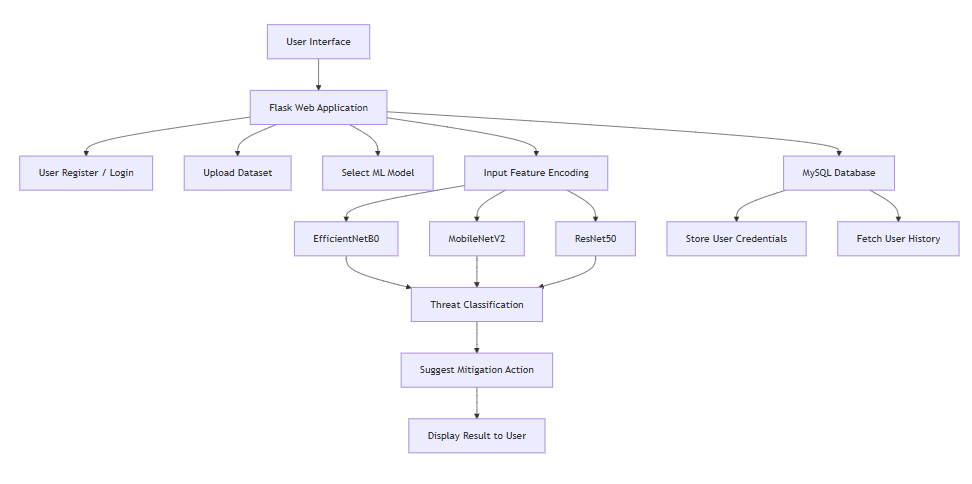
Specifications
SOFTWARE REQUIREMENS
Operating System : Windows 7/8/10
Server side Script : HTML, CSS, Bootstrap & JS
Programming Language : Python
Libraries : Flask, Pandas, Torch, Keras, Sklearn, Numpy , Seaborn
IDE/Workbench : VSCODE
Server Deployment : Xampp Server
Database : MySQL
HARDWARE REQUIREMENTS
Processor - I3/Intel Processor
RAM - 8GB (min)
Hard Disk - 128 GB
Key Board - Standard Windows Keyboard
Mouse - Two or Three Button Mouse
Monitor - Any


 Paper Publishing

Request Call Back
Would you like to receive a free callback now?
Choose the best time for callback:
Leave your message and we will contact you as soon as possible

6-2-85/B, Old Maternity Hospital Road, Thyagaraja Nagar, Tirupati, Andhra Pradesh – 517501
+91 9030333433
+91 9393939065
0877-2261612

Disclaimer - Takeoff Edu Group Projects are not associated or affiliated with IEEE in any way. The IEEE Projects mentioned here are mentioned in the context of student projects, whose ideas are derived from IEEE publications, not projects of or by IEEE.

